|
Efficient Open-Boundary Poisson Solves
Xingyu Ni, Jiong Chen, Siyuan Chen, Caoliwen Wang, Mathieu Desbrun, Taku Komura.
ACM Trans. Graph. (SIGGRAPH Asia) 45, 6, Article 180, 2026. See also the associated video.
Abstract:
Poisson equations arise pervasively in computer graphics, yet efficiently
solving them on unbounded domains remains a long-standing challenge.
Existing approaches attempting to model boundary conditions at infinity
either incur prohibitive computational costs by expanding the simulation
domain, sacrifice accuracy through artificial boundary conditions, or lack the flexibility to handle varying coefficients. In this paper, we introduce a simple and practical method for solving generalized Poisson equations on finite domains with open boundaries, enabling exact enforcement of asymptotic conditions at infinity. Our method couples a finite-volume interior solver with a boundary-element formulation of the exterior problem, enforcing continuity of both the solution and its normal derivative across an artificial boundary. Inspired by Johnson–Nédélec coupling and interface relaxation, we develop a partitioned, iterative scheme based on damped fixed-point iterations, which leverages fast, inexact boundary-element solves for the
exterior problem and efficient sparse solves for the interior. Theoretical
analysis and empirical tests confirm that our method provides superior
accuracy and performance compared to existing ad-hoc solutions across a
variety of graphics applications.
|
 |
Neural Field Processing on Surfaces
Weizhou Liu, Xingyu Ni, Mathieu Desbrun, Jiong Chen.
SIGGRAPH Asia Conference, Art. 37, 2026 (the pdf contains the accompanying supplemental material). See also the associated video.
Abstract:
We introduce a unified framework for neural field processing on surfaces
that combines implicit neural representations with the Closest Point Method
(CPM), enabling intrinsic surface computation to be carried out in ambient
Cartesian coordinates in a narrow band around the surface – with no explicit parameterization and no topology-dependent discretization. The framework rests on three technical contributions. First, we adapt CPM to the neural field setting: by extending field values constantly along surface normals, intrinsic differential operators reduce to their Cartesian counterparts and can be evaluated directly via a coordinate-based network. Second, we leverage the Hodge decomposition to encode surface vector fields entirely through neural scalar potentials, so that a single architecture handles scalar and vector surface fields alike, without frame-field choices or per-element discretization.
Third, for near-degenerate geometries such as thin structures with closely
spaced parallel faces, we lift the network input to the normal bundle to
suppress leakage between sheets that are close in space but far apart along
the surface. Under this formulation, a broad range of geometry processing
tasks including surface PDE solving, Laplacian eigenfunction computation,
reduced fluid simulation, and cross-field design for quad remeshing all reduce to variational problems solved by neural field optimization. Allowing boundary conditions or shape parameters as additional network inputs extends the benefit further: one network generalizes across an entire family of problem instances, replacing costly per-instance recomputation with fast feed-forward queries. Experimentally, we demonstrate accuracy competitive with FEM, a 30× speedup over neural competitors in eigenfunction computation, and superior cross-field quality compared to NeurCross.
|
 |
Fluid Simulation with the Lattice Boltzmann Method
Wei Li, Chaoyang Lyu, Mengyun Liu, Yixin Chen, Mathieu Desbrun, Kui Wu.
Course notes, ACM SIGGRAPH 2026. Code base available here
Abstract:
Macroscopic fluid flow solvers based on the incompressible Navier–Stokes equations are widely used in graphics, but achieving
high visual fidelity in complex scenarios—such as free-surface motion, high–Reynolds-number flows, multiphase flow effects, and
interactions with moving boundaries—often requires significant additional modeling and engineering effort. The kinetic Lattice
Boltzmann Method (LBM) has recently emerged as an attractive alternative for fluid flow simulation in this setting. Rather than
directly discretizing macroscopic flow equations, LBM evolves mesoscopic particle distribution functions on a regular Cartesian lattice
through simple, local collision and streaming operations. This local computational structure provides excellent data locality, maps
naturally to modern GPU architectures, and enables stable, efficient time integration in practice. In these course notes, we introduce
the fundamentals of the Lattice Boltzmann Method along with various recent advances that have fostered its use across a range of
applications relevant to graphics and simulation, including single- and multiphase flows, fluid–solid interaction, and learning-based
control for aerial and underwater robotics. We further discuss how LBM is used beyond academic research, highlighting its adoption
in industrial simulation tools and game production pipelines, as well as high-fidelity visual effects.
|
 |
Volume-Preserving LBM-MPM Coupling for Air-Water-Sand Mixtures
Xiaoyu Xiao, Haoxiang Wang, Xiaokang Yang, Mathieu Desbrun, Wei Li.
ACM Trans. Graph. (SIGGRAPH) 45, 4, Article 77, 2026. See also the video.
Abstract:
Simulating the dynamic, multiscale interactions between granular materials and multiphase fluids remains a significant computational challenge in computer graphics, as the visual complexity of such mixtures arises from strongly coupled small-scale structures.
We present a novel, physically-based simulation framework for sand-water-air mixtures that couples a Lattice Boltzmann Method (LBM) for weakly-compressible two-phase fluids with a Material Point Method (MPM) for granular sand.
Our approach is built upon a unified continuum formulation that expresses the governing equations for both fluid phases (air and water) and the granular medium within a consistent framework.
To accurately capture the transition of sand from a dry, friction-dominated state to a soaked, sticky medium, we introduce a water retention model that describes how liquid infiltrates and is retained within the granular structure.
Furthermore, we enforce volume conservation of the fluids within the mixture, ensuring numerical stability and physical realism.
Our robust coupling mechanism enables the simulation of complex phenomena such as sand mobilization, transport, settling, and erosion across a wide range of density ratios.
We demonstrate the efficiency of our method through several challenging scenarios, including the breaching of sand-walled basins, sediment-laden flows, and the erosive collapse of sand structures.
|
 |
SuperSDF: Sparse SDF Super-Resolution for Surface Extraction
Sagar Panwar, Nissim Maruani, Celine Loscos, Pierre Alliez, Mathieu Desbrun.
SIGGRAPH Conference, Art. 37, 2026
(the pdf contains the accompanying supplemental material). See also the video.
Abstract:
Signed Distance Fields (SDFs) are a powerful volumetric representation for 3D geometry. Recent
advances in surface generation from SDFs increasingly rely on learnable surface representations
and direct mesh supervision. In this work, we challenge this trend and show that high-quality
surface reconstruction can be achieved by learning to refine the volumetric signal itself. We
present SuperSDF, a learning-based approach for sparse SDF super-resolution that operates
directly in SDF space, without auxiliary surface representations or mesh-level supervision.
Using a sparse voxel neural network restricted to a narrow band near the surface, our method
predicts high-resolution signed-distance values from coarse inputs in a scalable and
resolution-agnostic manner. Standard isosurface extraction algorithms can then process the
resulting super-resolved SDFs to produce accurate, detailed surface meshes. Our results
show that learning-based SDF upsampling alone is sufficient to recover fine geometric details
missed by classical interpolation and prior reconstruction methods. Compared to state-of-the-art
machine learning approaches, our method generates higher-fidelity surfaces at a fraction of the
computational cost and scales to volumetric resolutions that were previously impractical.
|
 |
Illustrator's Depth: Monocular Layer Index Prediction for Image Decomposition
Nissim Maruani, Peiying Zhang, Siddhartha Chaudhuri, Matthew Fisher, Nanxuan Zhao, Vladimir G. Kim, Pierre Alliez, Mathieu Desbrun, Wang Yifan
CVPR, 2026.
See also the accompanying supplemental material,
video, and the
project page.
Abstract:
We introduce Illustrator’s Depth, a novel definition of depth that addresses a key challenge in digital content creation: decomposing
flat images into editable, ordered layers. Inspired by an artist’s compositional process, illustrator’s depth infers a layer index
for each pixel, forming an interpretable image decomposition through a discrete, globally consistent ordering of elements optimized for editability.
We also propose and train a neural network using a curated dataset of layered vector graphics to predict layering directly from raster inputs.
Our layer index inference unlocks a range of powerful downstream applications. In particular, it significantly outperforms state-of-the-art baselines
for image vectorization while also enabling high-fidelity text-to-vector-graphics generation, automatic 3D relief generation from 2D images, and
intuitive depth-aware editing. By reframing depth from a physical quantity to a creative abstraction, illustrator's depth prediction offers a new
foundation for editable image decomposition.
|
 |
A Posteriori Closure of Turbulence Models: Are
Symmetries Preserved?
André Freitas, Kiwon Um, Mathieu Desbrun, Michele Buzzicotti, Luca Biferale
European Journal of Mechanics - B/Fluids, vol. 119, Art. 204496, 2026.
Abstract:
Turbulence modeling remains a longstanding challenge in fluid dynamics. Recent advances in data-driven methods have led to a surge of novel approaches aimed at addressing this problem. This
work builds upon our recent work [Phys. Rev. Fluids 10, 044602 (2025)], where we introduced a
new closure for a shell model of turbulence using an a posteriori (or solver-in-the-loop) approach.
Unlike most deep learning-based models, our method explicitly incorporates physical equations
into the neural network framework, ensuring that the closure remains constrained by the underlying
physics benefiting from enhanced stability and generalizability. In this paper, we further analyze the
learned closure, probing its capabilities and limitations. In particular, we look at joint probability
density functions between resolved and unresolved variables, as well as the scale invariance of
multipliers (ratios between adjacent shells) within the inertial range. Although our model excels in
reproducing high-order statistical moments, it breaks this known symmetry near the cutoff, indicating
a fundamental limitation. We discuss the implications of these findings for subgrid-scale modeling in
3D turbulence and outline directions for future research.
|
 |
Efficient and Scalable Spatial Regularization of Optimal Transport
Lucas Brifault, David Cohen-Steiner, and Mathieu Desbrun
SIGGRAPH Asia, Art. 120, 2025. Honorable Mention, Best Paper Award. See also the accompanying Supplemental Material.
Abstract:
In this paper, we introduce a novel approach to spatial regularization of
optimal transport problems. Based on the notion of forward and backward
“mean maps” of a transport plan, we introduce a convex formulation of
optimal transport problems that incorporates regularization of these mean
maps to promote spatial continuity of the resulting optimal plan. Unlike
previous regularization approaches that required the optimization of all the
transport plan coefficients, our formulation translates into an ADMM-based
solver combined with Sinkhorn type algorithms, which drastically reduces
the number of variables and scales up to large problems. We demonstrate
the usefulness and efficiency of this new computational tool for various
applications and for different regularizations.
|
 |
Kinetic Free-Surface Flows and Foams with Sharp Interfaces
Haoxiang Wang, Kui Wu, Hui Qiao, Mathieu Desbrun, and Wei Li
ACM Trans.
Graph. 44, 6 (Art. 266), 2025. See also HOME-FREE code base.
Abstract:
Kinetic multiphase flow solvers have recently demonstrated exquisitely
complex and turbulent fluid phenomena involving splashing and bubbling.
However, they require full simulation of both the liquid phase and the air to
capture a large spectrum of fluid behaviors. Moreover, they rely on diffuse
interface tracking to properly account for the interfacial forces involved in
fluid-air interactions. Consequently, simulating visually appealing fluids is
extremely compute intensive given the required resolution to capture small
bubbles, and foam simulation is unattainable with this family of methods.
While water simulation involves density and viscosity differences between
the two phases so large that one can safely ignore the dynamics of air,
so-called kinetic free-surface solvers that only consider the liquid motion
have been unable to reproduce the full gamut of turbulent fluid behaviors,
being often unstable for even moderately complex scenarios. By revisiting
kinetic solvers using sharp interfaces and incorporating recent advances in
single-phase and multiphase LBM solvers, we propose a free-surface kinetic
solver, which we call HOME-FREE LBM, that not only handles turbulence,
glugging, and bubbling, but even foam where bubbles stick to each other
through surface tension. We demonstrate that our fluid simulator allows for
fast and robust bubble growth, breakup, and coalescence, at a fraction of the
computational time that existing CG fluid solvers require.
|
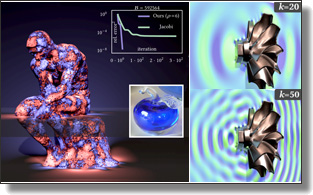 |
Lightning-fast Boundary Element Method
Jiong Chen, Florian Schäfer, and Mathieu Desbrun
ACM Trans. Graph. (SIGGRAPH) 44, 4, Art. 38, 2025. See also the accompanying video and the open-source repo.
Abstract:
Boundary element methods (BEM) for solving linear elliptic partial differential equations have gained traction in a wide range of graphics applications:
they eliminate the need for volumetric meshing by solving for variables
exclusively on the domain boundary through a linear boundary integral
equation (BIE). However, BEM often generate dense and ill-conditioned
linear systems that lead to poor computational scalability and substantial
memory demands for large-scale problems, limiting their applicability and
efficiency in practice.
In this paper, we address these limitations by generalizing the
Kaporin-based approach to asymmetric preconditioning: we
construct a sparse approximation of the inverse-LU factorization of arbitrary
BIE matrices in a massively parallel manner. Our sparse inverse-LU factorization, when employed as a preconditioner for the generalized minimal
residual (GMRES) method, significantly enhances the efficiency of BIE solves,
often yielding orders-of-magnitude speedups in solving times.
|
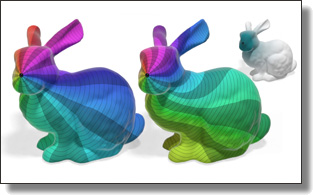 |
Discrete Torsion of Connection Forms on Simplicial Meshes
Theo Braune and Mark Gillespie, Yiying Tong, and Mathieu Desbrun
ACM Trans. Graph. (SIGGRAPH) 44, 4, Art. 67, 2025. See also the accompanying supplemental material.
Abstract:
While discrete (metric) connections have become a staple of n-vector field
design and analysis on simplicial meshes, the notion of torsion of a discrete
connection has remained unstudied. This is all the more surprising as torsion
is a crucial component in the fundamental theorem of Riemannian geometry,
which introduces the existence and uniqueness of the Levi-Civita connection
induced by the metric. In this paper, we extend the existing geometry
processing toolbox by providing torsion control over discrete connections. Our
approach consists in first introducing a new discrete Levi-Civita connection
for a metric with locally-constant curvature to replace the hinge connection
of a triangle mesh whose curvature is concentrated at singularities; from this
reference connection, we define the discrete torsion of a connection to be the
discrete dual 1-form by which a connection deviates from our discrete
Levi-Civita connection. We discuss how the curvature and torsion of a discrete
connection can then be controlled and assigned in a manner consistent with
the continuous case. We also illustrate our approach through theoretical
analysis and practical examples arising in vector and frame design.
|
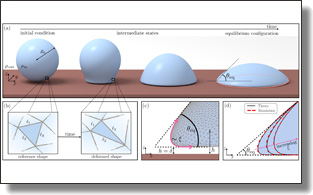 |
Immersed boundary-lattice Boltzmann mesoscale method for wetting problems
Elisa Bellantoni, Fabio Guglietta, Francesca Pelusi, Mathieu Desbrun,
Kiwon Um, Mihalis Nicolaou, Nikos Savva, and Mauro Sbragaglia
Physical Review E, 112(2), Art. 025305, 2025.
Abstract:
We develop a mesoscale computational model to describe the interaction of a droplet with a
solid. The model is based on the hybrid combination of the immersed boundary and the lattice
Boltzmann computational schemes: the former is used to model the non-ideal sharp interface of
the droplet coupled with the inner and outer fluids, simulated with the lattice Boltzmann scheme.
We further introduce an interaction force to model the wetting interactions of the droplet with
the solid at mesoscale: this interaction force is designed with the key computational advantage of providing a
regularization of the interface profile close to the contact line, avoiding abrupt curvature changes
that could otherwise cause numerical instabilities. The proposed model substantially improves
earlier immersed boundary - lattice Boltzmann models for wetting in that it allows a description
of an ample variety of wetting interactions, ranging from hydrophobic to hydrophilic cases, without
the need for any pre-calibration study on model parameters to be used. Model validations against
theoretical results for droplet shape at equilibrium and scaling laws for droplet spreading dynamics
are addressed.
|
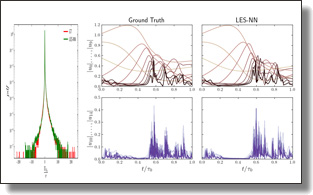 |
Solver-in-the-loop approach to closure of shell models of turbulence
André Freitas, Kiwon Um, Mathieu Desbrun, Michele Buzzicotti, and Luca Biferale
Physical Review Fluids, 10(4), Art. 044602, 2025.
Abstract:
This work studies an a posteriori data-driven approach (known as solver-in-the-loop) for subgrid modeling
of a shell model for turbulence. This approach takes advantage of the differentiable
physics paradigm of deep learning, allowing a neural network model to interact with the differential
equation solver over time during the training process. The closure model is, then, naturally exposed
to equations-informed input distributions by accounting for prior corrections over the temporal
evolution in training. Such a characteristic makes this approach depart from the conventional a
priori instantaneous training paradigm and often leads to a more accurate and stable closure model.
Our study demonstrates that the closure learned via this a posteriori approach is able to reproduce
high-order statistical moments of interest also in closures of high Reynolds number turbulence.
Moreover, we investigate the performance of the learned model by experimenting with the effect of
unrolling in time, which has remained for the most part unexplored in the literature. Finally, we
discuss potential extensions of this approach to Navier-Stokes equations.
|
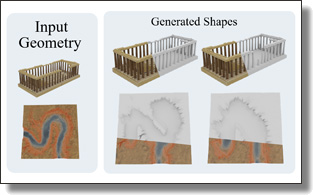 |
ShapeShifter: 3D Variations Using Multiscale and Sparse Point-Voxel Diffusion
Nissim Maruani, Yifan Wang, Matthew Fisher, Pierre Alliez, and Mathieu Desbrun
CVPR, 2025.
See also the accompanying supplemental material, video, and the project page.
Abstract:
This paper proposes ShapeShifter, a new 3D generative model that learns to synthesize shape variations based on a single reference model.
While generative methods for 3D objects have recently attracted much attention, current techniques often lack geometric details and/or require
long training times and large resources. Our approach remedies these issues by combining sparse voxel grids and point, normal, and color sampling within
a multiscale neural architecture that can be trained efficiently and in parallel. We show that our resulting variations better capture the fine details of
their original input and can handle more general types of surfaces than previous SDF-based methods. Moreover, we offer interactive generation of 3D shape
variants, allowing more human control in the design loop if needed.
|
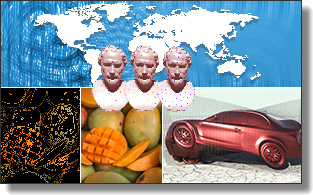 |
Lightning-fast Method of Fundamental Solutions
Jiong Chen, Florian Schäfer, and Mathieu Desbrun
ACM Trans. Graph. 43, 4, Article 77 (SIGGRAPH), 2024. Best Paper Award.
Abstract:
The method of fundamental solutions (MFS) and its associated boundary element method (BEM) have gained popularity in computer graphics due to the reduced dimensionality they offer:
for three-dimensional linear problems, they only require variables on the domain boundary to solve and evaluate the solution throughout space,
making them a valuable tool in a wide variety of applications.
However, MFS and BEM have poor computational scalability and huge memory requirements for large-scale problems, limiting their applicability and efficiency in practice.
By leveraging connections with Gaussian Processes and exploiting the sparse structure of the inverses of boundary integral matrices, we introduce a variational preconditioner that can be computed via a sparse inverse-Cholesky factorization in a massively parallel manner.
We show that applying our preconditioner to the Preconditioned Conjugate Gradient algorithm greatly improves the efficiency of MFS or BEM solves, up to four orders of magnitude in our series of tests.
|
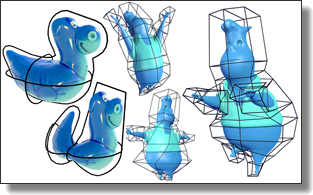 |
Stochastic Computation of Barycentric Coordinates
Fernando de Goes and Mathieu Desbrun
ACM Trans. Graph. 43, 4, Article 42 (SIGGRAPH), 2024.
See also the accompanying video.
Abstract:
This paper presents a practical and general approach for computing barycentric coordinates through stochastic sampling. Our key insight is a reformulation of the kernel integral defining barycentric coordinates into a weighted least-squares minimization that enables Monte Carlo integration without sacrificing linear precision. Our method can thus compute barycentric coordinates directly at the points of interest, both inside and outside the cage, using just proximity queries to the cage such as closest points and ray intersections. As a result, we can evaluate barycentric coordinates for a large variety of cage representations (from quadrangulated surface meshes to parametric curves) seamlessly, bypassing any volumetric discretization or custom solves. To address the archetypal noise induced by sample-based estimates, we also introduce a denoising scheme tailored to barycentric coordinates. We demonstrate the efficiency and flexibility of our formulation by implementing a stochastic generation of harmonic coordinates, mean-value coordinates, and positive mean-value coordinates.
|
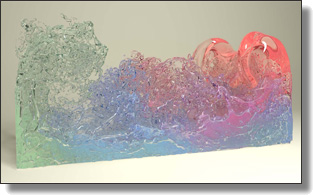 |
Kinetic Simulation of Turbulent Multifluid Flows
Wei Li, Kui Wu, and Mathieu Desbrun
ACM Trans. Graph. 43, 4, Article 55 (SIGGRAPH), 2024.
See also the accompanying video.
Abstract:
Despite its visual appeal, the simulation of separated multiphase flows (i.e., streams of fluids separated by interfaces)
faces numerous challenges in accurately reproducing complex behaviors such as guggling, wetting, or bubbling. These difficulties are especially pronounced for high Reynolds numbers and large density variations between fluids, most likely explaining why they have received comparatively little attention in Computer Graphics compared to single- or two-phase flows.
In this paper, we present a full LBM solver for multifluid simulation. We derive a conservative phase field model with which
the spatial presence of each fluid or phase is encoded to allow for the simulation of miscible, immiscible and even
partially-miscible fluids, while the temporal evolution of the phases is performed using a D3Q7 lattice-Boltzmann
discretization. The velocity field, handled through the recent high-order moment-encoded LBM (HOME-LBM) framework to
minimize its memory footprint, is simulated via a velocity-based distribution stored on a D3Q27 or D3Q19 discretization to
offer accuracy and stability to large density ratios even in turbulent scenarios, while coupling with the phases through
pressure, viscosity, and interfacial forces is achieved by leveraging the diffuse encoding of interfaces. The resulting
solver addresses a number of limitations of kinetic methods in both computational fluid dynamics and computer graphics: it
offers a fast, accurate, and low-memory fluid solver enabling efficient turbulent multiphase simulations free of the typical
oscillatory pressure behavior near boundaries. We present several numerical benchmarks, examples and comparisons of multiphase
flows to demonstrate our solver's visual complexity, accuracy, and realism.
|
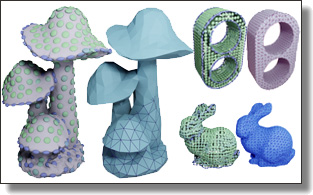 |
PoNQ: a Neural QEM-based Mesh Representation
Nissim Maruani, Maks Ovsjanikov, Pierre Alliez, and Mathieu Desbrun
CVPR, 2024.
See also the project page, the accompanying video,
the Supplementary Material, code, or data.
Abstract:
Although polygon meshes have been a standard rep resentation in geometry processing, their irregular and
combinatorial nature hinders their suitability for learning based applications. In this work, we introduce a novel
learnable mesh representation through a set of local 3D sample Points and their associated Normals and Quadric
error metrics (QEM) w.r.t. the underlying shape, which we denote PoNQ. A global mesh is directly derived from PoNQ
by efficiently leveraging the knowledge of the local quadric errors. Besides marking the first use of QEM within a neu ral shape representation, our contribution guarantees both
topological and geometrical properties by ensuring that a PoNQ mesh does not self-intersect and is always the bound ary of a volume. Notably, our representation does not rely
on a regular grid, is supervised directly by the target sur face alone, and also handles open surfaces with boundaries
and/or sharp features. We demonstrate the efficacy of PoNQ through a learning-based mesh prediction from SDF grids
and show that our method surpasses recent state-of-the-art techniques in terms of both surface and edge-based metrics.
|
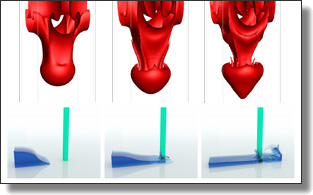 |
Hybrid LBM-FVM Solver for Two-phase Flow Simulation
Yihui Ma, Xiaoyu Xiao, Wei Li, Mathieu Desbrun, and Xiaopei Liu
Journal of Computational Physics, 506, Art. 112920, 2024.
Abstract:
In this paper, we introduce a hybrid LBM-FVM solver for two-phase fluid flow simulations
in which interface dynamics is modeled by a conservative phase-field equation. Integrating
fluid equations over time is achieved through a velocity-based lattice Boltzmann solver which
is improved by a central-moment multiple-relaxation-time collision model to reach higher
accuracy. For interface evolution, we propose a finite-volume-based numerical treatment for the
integration of the phase-field equation: we show that the second-order isotropic centered stencils
for diffusive and separation fluxes combined with the WENO-5 stencils for advective fluxes
achieve similar and sometimes even higher accuracy than the state-of-the-art double-distribution function LBM methods as well as the DUGKS-based method, while requiring less computations
and a smaller amount of memory. Benchmark tests (such as the 2D diagonal translation of a
circular interface), along with quantitative evaluations on more complex tests (such as the rising
bubble and Rayleigh-Taylor instability simulations) allowing comparisons with prior numerical
methods and/or experimental data, are presented to validate the advantage of our hybrid solver.
Moreover, 3D simulations (including a dam break simulation) are also compared to the time-lapse
photography of physical experiments in order to allow for more qualitative evaluations.
|
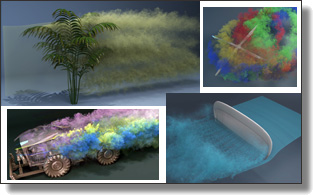 |
High-Order Moment-Encoded Kinetic Simulation of Turbulent Flows
Wei Li, Tongtong Wang, Zherong Pang, Xifeng Gao, Kui Wu, and Mathieu Desbrun
ACM Trans. Graph. (SIGGRAPH Asia), 42(6), 2023.
See also its accompanying video.
Abstract:
Kinetic solvers for incompressible fluid simulation were designed to run efficiently on massively parallel architectures such as GPUs. While these lattice Boltzmann solvers have recently proven much faster and more accurate than the macroscopic Navier-Stokes-based solvers traditionally used
in graphics, it systematically comes at the price of a very large memory requirement: a mesoscopic discretization of statistical mechanics requires
over an order of magnitude more variables per grid node than most fluid solvers in graphics. In order to open up kinetic simulation to gaming and
simulation software packages on commodity hardware, we propose a High-Order Moment-Encoded Lattice-Boltzmann-Method solver which we coined
HOME-LBM, requiring only the storage of a few moments per grid node, with little to no loss of accuracy in the typical simulation scenarios encountered in graphics. We show that our lightweight and lightspeed fluid solver requires three times less memory and runs ten times faster than
state-of-the-art kinetic solvers, for a nearly-identical visual output.
|
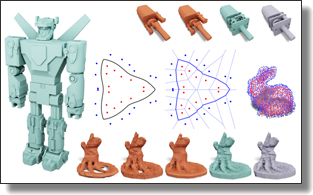 |
VoroMesh: Learning Watertight Surface Meshes with Voronoi Diagrams
Nissim Maruani, Roman, Koklov, Maks Ovsjanikov, Pierre Alliez, and Mathieu Desbrun
International Conference on Computer Vision 2023.
See also its accompanying Supplementary Material, video and code, or checkout the project page for more info.
Abstract:
In stark contrast to the case of images, finding a concise, learnable discrete representation of 3D surfaces remains a challenge. In particular, while polygon meshes are arguably the most common surface representation used in geometry processing, their irregular and combinatorial structure often make them unsuitable for learning-based applications. In this work, we present VoroMesh, a novel and differentiable Voronoi-based representation of watertight 3D shape surfaces. From a set of 3D points (called generators) and their associated occupancy, we define our boundary representation through the Voronoi diagram of the generators as the subset of Voronoi faces whose two associated (equidistant) generators are of opposite occupancy: the resulting polygon mesh forms a watertight approximation of the target shape's boundary. To learn the position of the generators, we propose a novel loss function, dubbed VoroLoss, that minimizes the distance from ground truth surface samples to the closest faces of the Voronoi diagram which does not require an explicit construction of the entire Voronoi diagram. A direct optimization of the Voroloss to obtain generators on the Thingi32 dataset demonstrates the geometric efficiency of our representation compared to axiomatic meshing algorithms and recent learning-based mesh representations. We further use VoroMesh in a learning-based mesh prediction task from input SDF grids on the ABC dataset, and show comparable performance to state-of-the-art methods while guaranteeing closed output surfaces free of self-intersections.
|
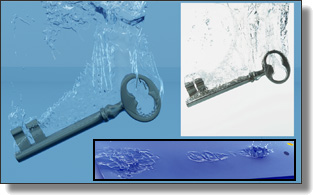 |
Fluid-Solid Coupling in Kinetic Two-Phase Flow Simulation
Wei Li, and Mathieu Desbrun
ACM Trans. Graph. (SIGGRAPH), 42(4), 2023.
See also its accompanying video.
Abstract:
Real-life flows exhibit complex and visually appealing behaviors such as bubbling, splashing, glugging and wetting that simulation techniques in
graphics have attempted to capture for years. While early approaches were not capable of reproducing multiphase flow phenomena due to their ex-
cessive numerical viscosity and low accuracy, kinetic solvers based on the lattice Boltzmann method have recently demonstrated the ability to simulate water-air interaction at high Reynolds numbers in a massively-parallel fashion. However, robust and accurate handling of fluid-solid coupling has
remained elusive: be it for CG or CFD solvers, as soon as the motion of immersed objects is too fast or too sudden, pressures near boundaries and
interfacial forces exhibit spurious oscillations leading to blowups. Built upon a phase-field and velocity-distribution based lattice-Boltzmann solver for
multiphase flows, this paper spells out a series of numerical improvements in momentum exchange, interfacial forces, and two-way coupling to drastically reduce these typical artifacts, thus significantly expanding the types of fluid-solid coupling that we can efficiently simulate. We highlight the
numerical benefits of our solver through various challenging simulation results, including comparisons to previous work and real footage.
|
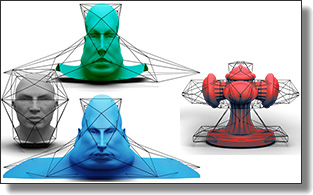 |
Somigliana Coordinates: an elasticity-derived approach for cage deformation
Jiong Chen, Fernando de Goes, and Mathieu Desbrun
ACM SIGGRAPH conference, Art. 52, 2023.
See also its accompanying its supplemental material.
Abstract:
In this paper, we present a novel cage deformer based on elasticity-derived matrix-valued coordinates. In order to bypass the typical shearing artifacts
and lack of volume control of existing cage deformers, we promote a more elastic behavior of the cage deformation by deriving our coordinates from
the Somigliana identity, a boundary integral formulation based on the fundamental solution of linear elasticity. Given an initial cage and its deformed
pose, the deformation of the cage interior is deduced from these Somigliana coordinates via a corotational scheme, resulting in a matrix-weighted combi-
nation of both vertex positions and face normals of the cage. Our deformer thus generalizes Green coordinates, while producing physically-plausible
spatial deformations that are invariant under similarity transformations and with interactive bulging control. We demonstrate the efficiency and
versatility of our method through a series of examples in 2D and 3D.
|
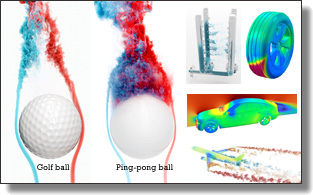 |
Building a Virtual Weakly-Compressible Wind Tunnel Testing Facility
Chaoyang Lyu, Kai Bai, Yiheng Wu, Mathieu Desbrun, Changxi Zheng, and Xiaopei Liu
ACM Trans. Graph. (SIGGRAPH), 42(4), 2023.
See also its accompanying video, and its supplemental material.
Abstract:
Virtual wind tunnel testing is a key ingredient in the engineering design process for the automotive and aeronautical industries as well as for urban
planning: through visualization and analysis of the simulation data, it helps optimize lift and drag coefficients, increase peak speed, detect high pressure
zones, and reduce wind noise at low cost prior to manufacturing. In this paper, we develop an efficient and accurate virtual wind tunnel system based
on recent contributions from both computer graphics and computational fluid dynamics in high-performance kinetic solvers. Running on one or multiple GPUs, our massively-parallel lattice Boltzmann model meets industry standards for accuracy and consistency while exceeding current mainstream industrial solutions in terms of efficiency Ð especially for unsteady turbulent flow simulation at very high Reynolds number (on the order of 10^7) -- due to key contributions in improved collision modeling and boundary treatment, automatic construction of multiresolution grids for complex models, as well as performance optimization. We demonstrate the efficacy and reliability of our virtual wind tunnel testing facility through comparisons of our results to multiple benchmark tests, showing an increase in both accuracy and efficiency compared to state-of-the-art industrial solutions. We also illustrate the fine turbulence structures that our system can capture, indicating the relevance of our solver for both VFX and industrial product design.
|
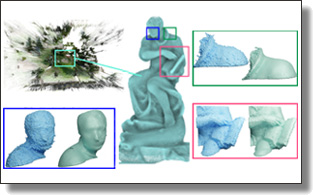 |
Robust Pointset Denoising of
Piecewise-Smooth Surfaces through Line Processes
Jiayi Wei, Jiong Chen, Damien Rohmer, Pooran Memari, and Mathieu Desbrun
Computer Graphics Forum, 42(2), 2023.
Abstract:
Denoising is a common, yet critical operation in geometry processing aiming at recovering high-fidelity models of piecewisesmooth
objects from noise-corrupted pointsets. Despite a sizable literature on the topic, there is a dearth of approaches capable
of processing very noisy and outlier-ridden input pointsets for which no normal estimates and no assumptions on the underlying
geometric features or noise type are provided. In this paper, we propose a new robust-statistics approach to denoising pointsets
based on line processes to offer robustness to noise and outliers while preserving sharp features possibly present in the data.
While the use of robust statistics in denoising is hardly new, most approaches rely on prescribed filtering using data-independent
blending expressions based on the spatial and normal closeness of samples. Instead, our approach deduces a geometric denoising
strategy through robust and regularized tangent plane fitting of the initial pointset, obtained numerically via alternating
minimizations for efficiency and reliability. Key to our variational approach is the use of line processes to identify inliers vs.
outliers, as well as the presence of sharp features. We demonstrate that our method can denoise sampled piecewise-smooth
surfaces for levels of noise and outliers at which previous works fall short.
|
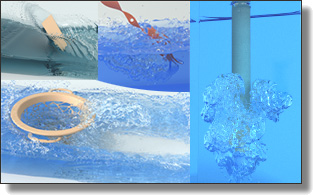 |
Efficient Kinetic Simulation of Two-Phase Flows
Wei Li, Yihui Ma, Xiaopei Liu and Mathieu Desbrun
ACM Trans. Graph. (SIGGRAPH), 41(4), Art. 114, 2022.
See also its accompanying video, and its supplemental material.
.
Abstract:
Real-life multiphase flows exhibit a number of complex and visually appealing
behaviors, involving bubbling, wetting, splashing, and glugging.
However, most state-of-the-art simulation techniques in graphics can only
demonstrate a limited range of multiphase flow phenomena, due to their
inability to handle the real water-air density ratio and to the large amount
of numerical viscosity introduced in the flow simulation and its coupling
with the interface. Recently, kinetic-based methods have achieved success
in simulating large density ratios and high Reynolds numbers efficiently;
but their memory overhead, limited stability, and numerically-intensive
treatment of coupling with immersed solids remain enduring obstacles to
their adoption in movie productions. In this paper, we propose a new kinetic
solver to couple the incompressible Navier-Stokes equations with a conservative
phase-field equation which remedies these major practical hurdles.
The resulting two-phase immiscible fluid solver is shown to be efficient due
to its massively-parallel nature and GPU implementation, as well as very
versatile and reliable because of its enhanced stability to large density ratios,
high Reynolds numbers, and complex solid boundaries. We highlight the
advantages of our solver through various challenging simulation results that
capture intricate and turbulent air-water interaction, including comparisons
to previous work and real footage.
|
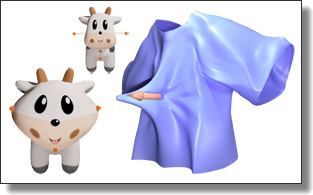 |
Go Green: General Regularized Green’s Functions for Elasticity
Jiong Chen and Mathieu Desbrun
SIGGRAPH conference, Art. 6, 2022.
See also supplemental material.
Abstract:
The fundamental solutions (Green’s functions) of linear elasticity for an
infinite and isotropic media are ubiquitous in interactive graphics applications
that cannot afford the computational costs of volumetric meshing
and finite-element simulation. For instance, the recent work of de Goes and
James [2017] leveraged these Green’s functions to formulate sculpting tools
capturing in real-time broad and physically-plausible deformations more
intuitively and realistically than traditional editing brushes. In this paper,
we extend this family of Green’s functions by exploiting the anisotropic
behavior of general linear elastic materials, where the relationship between
stress and strain in the material depends on its orientation. While this more
general framework prevents the existence of analytical expressions for its
fundamental solutions, we show that a finite sum of spherical harmonics can
be used to decompose a Green’s function, which can be further factorized
into directional, radial, and material-dependent terms. From such a decoupling,
we show how to numerically derive sculpting brushes to generate
anisotropic deformation and finely control their falloff profiles in real-time.
|
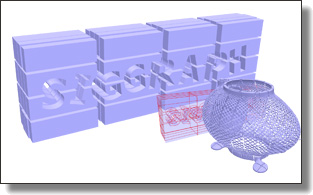 |
TopoCut: Fast and Robust Planar Cutting of Arbitrary Domains
Xianzhong Fang, Mathieu Desbrun, Hujun Bai, and Jin Huang
ACM Trans. Graph. (SIGGRAPH), 41(4), Art. 40, 2022.
See also its accompanying supplemental material.
Abstract:
Given a complex three-dimensional domain delimited by a closed and nondegenerate
input triangle mesh without any self-intersection, a common geometry
processing task consists in cutting up the domain into cells through a
set of planar cuts, creating a “cut-cell mesh”, i.e., a volumetric decomposition
of the domain amenable to visualization (e.g., exploded views), animation
(e.g., virtual surgery), or simulation (finite volume computations). A large
number of methods have proposed either efficient or robust solutions, sometimes
restricting the cuts to form a regular or adaptive grid for simplicity;
yet, none can guarantee both properties, severely limiting their usefulness
in practice. At the core of the difficulty is the determination of topological
relationships among large numbers of vertices, edges, faces and cells in order
to assemble a proper cut-cell mesh: while exact geometric computations
provide a robust solution to this issue, their high computational cost has
prompted a number of faster solutions based on, e.g., local floating-point
angle sorting to significantly accelerate the process — but losing robustness
in doing so. In this paper, we introduce a new approach to planar cutting of
3D domains that substitutes topological inference for numerical ordering
through a novel mesh data structure, and revert to exact numerical evaluations
only in the few rare cases where it is strictly necessary. We show
that our novel concept of topological cuts exploits the inherent structure of
cut-cell mesh generation to save computational time while still guaranteeing
exactness for, and robustness to, arbitrary cuts and surface geometry. We
demonstrate the superiority of our approach over state-of-the-art methods
on almost 10,000 meshes with a wide range of geometric and topological
complexity. We also provide an open source implementation.
|
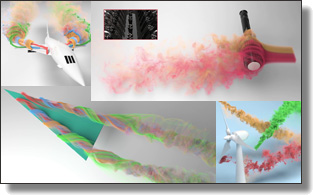 |
Fast and Versatile Fluid-Solid Coupling for Turbulent Flow Simulation
Chaoyang Lyu, Wei Li, Mathieu Desbrun, and Xiaopei Liu
ACM Trans. Graph. (SIGGRAPH), 40(6), Art. 201, 2021.
See also its accompanying video.
2D code to come, please wait.
Abstract:
The intricate motions and complex vortical structures generated by the interaction between fluids and solids are visually fascinating. However, reproducing such a two-way coupling between thin objects and turbulent fluids numerically is notoriously challenging and computationally costly: existing approaches such as cut-cell or immersed-boundary methods have difficulty achieving physical accuracy, or even visual plausibility, of simulations involving fast-evolving flows with immersed objects of arbitrary shapes.
In this paper, we propose an efficient and versatile approach for simulating two-way fluid-solid coupling within the kinetic (lattice-Boltzmann) fluid simulation framework, valid for both laminar and highly turbulent flows, and for both thick and thin objects.
We introduce a novel hybrid approach to fluid-solid coupling which systematically involves a mesoscopic double-sided bounce-back scheme followed by a cut-cell velocity correction for a more robust and plausible treatment of turbulent flows near moving (thin) solids, preventing flow penetration and reducing boundary artifacts significantly.
Coupled with an efficient approximation to simplify geometric computations,
the whole boundary treatment method preserves the inherent massively parallel computational nature of the kinetic method.
Moreover, we propose simple GPU optimizations of the core LBM algorithm which achieve an even higher computational
efficiency than the state-of-the-art kinetic fluid solvers in graphics. We demonstrate the accuracy and efficacy of our two-way coupling through various challenging simulations involving a variety of rigid body solids and fluids at both high and low Reynolds numbers.
Finally, comparisons to existing methods on benchmark data and real experiments further highlight the superiority of our method.
|
 |
Predicting High-Resolution Turbulence Details in Space and Time
Kai Bai, Chunhao Wang, Mathieu Desbrun, and Xiaopei Liu
ACM Trans. Graph. (SIGGRAPH), 40(6), Art. 200, 2021.
See also its accompanying video.
Code to come, please wait.
Abstract:
Predicting the fine and intricate details of a turbulent flow field in both space and time
from a coarse input remains a major challenge despite the availability of modern machine learning tools.
In this paper, we present a simple and effective dictionary-based approach to spatio-temporal upsampling of fluid simulation.
We demonstrate that our neural network approach can reproduce the visual complexity of turbulent flows from spatially and temporally coarse velocity fields even when using a generic training set.
Moreover, since our method generates finer spatial and/or temporal details through embarrassingly-parallel upsampling of small local patches, it can efficiently predict high-resolution turbulence details across a variety of grid resolutions. As a consequence, our method offers a whole range of applications varying from fluid flow upsampling to fluid data compression.
We demonstrate the efficiency and generalizability of our method for synthesizing turbulent flows
on a series of complex examples, highlighting dramatically better results in spatio-temporal upsampling and
flow data compression than existing methods as assessed by both qualitative and quantitative comparisons.
|
 |
Q-zip: Singularity Editing Primitive for Quad Meshes
Leman Feng, Yiying Tong, and Mathieu Desbrun
ACM Trans. Graph. (SIGGRAPH), 40(6), Art. 258, 2021.
Check out its accompanying supplemental material (code, meshes) too.
Abstract:
Singularity editing of a quadrangle mesh consists in shifting singularities
around for either improving the quality of the mesh elements or canceling
extraneous singularities, so as to increase mesh regularity. However, the
particular structure of a quad mesh renders the exploration of allowable
connectivity changes non-local and hard to automate. In this paper, we
introduce a simple, principled, and general quad-mesh editing primitive with
which pairs of arbitrarily distant singularities can be efficiently displaced
around a mesh through a deterministic and reversible chain of local topological
operations with a minimal footprint. Dubbed Q-zip as it acts as a zipper
opening up and collapsing down quad strips, our practical mesh operator
for singularity editing can be easily implemented via parallel transport of
a reference compass between any two irregular vertices. Batches of Q-zips
performed in parallel can then be used for efficient singularity editing.
|
 |
Multiscale Cholesky Preconditioning for Ill-conditioned Problems
Jiong Chen, Florian Schäfer, Jin Huang, Mathieu Desbrun
ACM Trans. Graph. (SIGGRAPH), 40(4), Art. 81, 2021.
See also its accompanying implementation
(with replicability stamp).
Abstract:
Many computer graphics applications boil down to solving sparse systems
of linear equations. While the current arsenal of numerical solvers available
in various specialized libraries and for different computer architectures often
allow efficient and scalable solutions to image processing, modeling and
simulation applications, an increasing number of graphics problems face
large-scale and ill-conditioned sparse linear systems -- a numerical challenge
which typically chokes both direct factorizations (due to high memory
requirements) and iterative solvers (because of slow convergence). We propose
a novel approach to the efficient preconditioning of such problems which
often emerge from the discretization over unstructured meshes of partial
differential equations with heterogeneous and anisotropic coefficients. Our
numerical approach consists in simply performing a fine-to-coarse ordering
and a multiscale sparsity pattern of the degrees of freedom, using which
we apply an incomplete Cholesky factorization. By further leveraging
supernodes for cache coherence, graph coloring to improve parallelism and
partial diagonal shifting to remedy negative pivots, we obtain a preconditioner
which, combined with a conjugate gradient solver, far exceeds the
performance of existing carefully-engineered libraries for graphics problems
involving bad mesh elements and/or high contrast of coefficients. We also
back the core concepts behind our simple solver with theoretical foundations
linking the recent method of operator-adapted wavelets used in numerical
homogenization to the traditional Cholesky factorization of a matrix,
providing us with a clear bridge between incomplete Cholesky factorization
and multiscale analysis that we leverage numerically.
|
 |
Dynamic Upsampling of Smoke through Dictionary-based Learning
Kai Bai, Wei Li, Mathieu Desbrun, Xiaopei Liu
ACM Trans. Graph., 40(1), Art. 4, 2020.
Abstract:
Simulating turbulent smoke flows with fine details is computationally intensive.
For iterative editing or simply faster generation, efficiently upsampling a low-resolution numerical simulation is an attractive alternative.
We propose a novel learning approach to the dynamic upsampling of smoke flows based on a training set of flows at coarse and fine resolutions.
Our multiscale neural network turns an input coarse animation into a sparse linear combination of small velocity patches present in a precomputed over-complete dictionary. These sparse coefficients are then used to generate a high-resolution smoke animation sequence by blending the fine counterparts of the coarse patches.
Our network is initially trained from a sequence of example simulations to both construct the dictionary of corresponding coarse and fine patches and allow for the fast evaluation of a sparse patch encoding of any coarse input.
The resulting network provides an accurate upsampling when the coarse input simulation is well approximated by patches present in the training set (e.g., for re-simulation), or simply visually-plausible upsampling when input and training set differ significantly.
We show a variety of examples to ascertain the strengths and limitations of our approach, and offer comparisons to existing approaches to demonstrate its quality and effectiveness.
|
 |
Discrete Differential Operators on Polygonal Meshes
Fernando de Goes, Andrew Butts, Mathieu Desbrun
ACM Trans. Graph. (SIGGRAPH), 39(4), Art. 110, 2020.
Abstract:
Geometry processing of surface meshes relies heavily on the discretization of differential operators such as gradient, Laplacian, and covariant derivative. While a variety of discrete operators over triangulated meshes have been developed and used for decades, a similar construction over polygonal meshes remains far less explored despite the prevalence of non-simplicial surfaces in geometric design and engineering applications. This paper introduces a principled construction of discrete differential operators on surface meshes formed by (possibly non-flat and non-convex) polygonal faces. Our approach is based on a novel mimetic discretization of the gradient operator that is linear-precise on arbitrary polygons. Equipped with this discrete gradient, we draw upon ideas from the Virtual Element Method in order to derive a series of discrete operators commonly used in graphics that are now valid over polygonal surfaces. We demonstrate the accuracy and robustness of our resulting operators through various numerical examples, before incorporating them into existing geometry processing algorithms.
|
 |
Fast and Scalable Turbulent Flow Simulation with Two-Way Coupling
Wei Li, Yixin Chen, Mathieu Desbrun, Changxi Zheng, Xiaopei Liu
ACM Trans. Graph. (SIGGRAPH), 39(4), Art. 47, 2020. See also its accompanying video and its supplemental material.
Abstract:
Despite their cinematic appeal, turbulent flows involving fluid-solid coupling remain a computational challenge in animation.
At the root of this current limitation is the numerical dispersion from which most accurate Navier-Stokes solvers suffer:
proper coupling between fluid and solid often generates artificial dispersion in the form of local, parasitic trains of velocity oscillations, eventually leading to numerical instability.
While successive improvements over the years have led to conservative and detail-preserving fluid integrators,
the dispersive nature of these solvers is rarely discussed despite its dramatic impact on fluid-structure interaction.
In this paper, we introduce a novel low-dissipation and low-dispersion fluid solver that can simulate two-way coupling in an efficient and scalable manner, even for turbulent flows. In sharp contrast with most current CG approaches, we construct our solver from a kinetic formulation of the flow derived from statistical mechanics. Unlike existing lattice Boltzmann solvers, our approach leverages high-order moment relaxations as a key to controlling both dissipation and dispersion of the resulting scheme. Moreover, we combine our new fluid solver with the immersed boundary method to easily handle fluid-solid coupling through time adaptive simulations.
Our kinetic solver is highly parallelizable by nature, making it ideally suited for implementation on single- or multi-GPU computing platforms. Extensive comparisons with existing solvers on synthetic tests and real-life experiments are used to highlight the multiple advantages of our work over traditional and more recent approaches, in terms of accuracy, scalability, and efficiency.
|
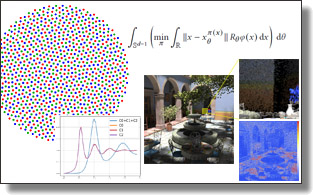 |
Sliced Optimal Transport Sampling
Lois Paulin, Nicolas Bonneel, David Coeurjolly, Jean-Claude Iehl, Antoine Webanck, Mathieu Desbrun, Victor Ostromoukhov
ACM Trans. Graph. (SIGGRAPH), 39(4), Art. 99, 2020. See also its supplemental material, as well as the project page.
Abstract:
In this paper, we introduce a numerical technique to generate sample distributions in arbitrary dimension for improved accuracy of Monte Carlo integration. We point out that optimal transport offers theoretical bounds on Monte Carlo integration error, and that the recently-introduced numerical framework of sliced optimal transport (SOT) allows us to formulate a novel and efficient approach to generating well-distributed high-dimensional pointsets. The resulting sliced optimal transport sampling, solely involving repeated 1D solves, is particularly simple and efficient for the common case of a uniform density over a $d$-dimensional ball. We also construct a volume-preserving map from a $d$-ball to a $d$-cube (generalizing the Shirley-Chiu mapping to arbitrary dimensions) to offer fast SOT sampling over $d$-cubes. We provide ample numerical evidence of the improvement in Monte Carlo integration accuracy that SOT sampling brings compared to existing QMC techniques, and derive a projective variant for rendering which outperforms, at times significantly, current sampling strategies using low-discrepancy sequences or optimized samples.
|
 |
Kinetic-based Multiphase Flow Simulation
Wei Li, Daoming Liu, Mathieu Desbrun, Jin Huang, Xiaopei Liu
IEEE Trans. Vis. Comp. Graph., 27(7), pages 3318--3334, 2021. See also its accompanying video.
Abstract:
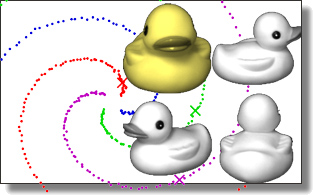
Simulating turbulent smoke flows is computationally intensive due to their intrinsic multiscale behavior, thus requiring sophisticated non-dissipative solvers with relatively high resolution to fully capture their complexity.
For iterative editing or simply faster generation of smoke flows, dynamic upsampling of an input low-resolution numerical simulation is an attractive, yet currently unattainable goal.
In this paper, we propose a novel dictionary-based learning approach to the dynamic upsampling of smoke flows.
For each frame of an input coarse animation, we seek a sparse representation of small, local velocity patches of the flow based on an over-complete dictionary, and use the resulting sparse coefficients to generate a high-resolution animation sequence.
We introduce a neural network which learns both a fast evaluation of sparse patch encoding and a dictionary of corresponding coarse and fine patches from a sequence of simulations computed with any numerical solver. Because our approach amounts to learning the integration of fine Navier-Stokes flow patches from their counterparts simulated on a coarse grid, our upsampling process injects into coarse input sequences physics-driven fine details, unlike most previous approaches that only employed fast procedural models to add high frequency to the input. Our use of sparse representation also avoids excessive blurring during synthesis while retaining complex structures, thus offering increased efficiency and visual realism.
Using a training set composed of local patches of the velocity field from a set of coarse and fine simulation pairs, our approach can upsample an arbitrary coarse simulation, very accurately if the training examples cover enough dynamic variety, or just plausibly otherwise.
We present a variety of upsampling results for smoke flows with different training settings (generalized synthesis, restricted synthesis and re-simulation) exhibiting different synthesis quality, and offer comparisons to their corresponding high-resolution simulations to indicate the effectiveness of our approach to efficiently and realistically simulating high-resolution smoke flows.
|
 |
Laplacian-Optimized Diffusion for Semi-Supervised Learning
Max Budninskiy, Ameera Abdelaziz, Yiying Tong, and Mathieu Desbrun
Computer Aided Geometric Design (special issue on Geometric Modeling and Processing), 79:101864, 2020.
Abstract:
Semi-supervised learning (SSL) is fundamentally a geometric task:
in order to classify high-dimensional point sets when only a small fraction of data points are labeled, the geometry of the unlabeled data points is exploited to gain better classifying accuracy. A number of state-of-the-art SSL techniques rely on label propagation through graph-based diffusion, with edge weights that are evaluated either analytically from the data or through compute-intensive training based on nonlinear and nonconvex optimization. In this paper,
we bring discrete differential geometry to bear on this problem by introducing
a graph-based SSL approach where label diffusion uses a Laplacian operator learned from the geometry of the input data. From a data-dependent graph of the input, we formulate a biconvex loss function in terms of graph edge weights and inferred labels. Its minimization is achieved through alternating rounds of optimization of the Laplacian and diffusion-based inference of labels. The resulting optimized Laplacian diffusion directionally adapts to the intrinsic geometric structure of the data which often concentrates in clusters or around low-dimensional manifolds within the high-dimensional representation space. We show on a range of classical datasets that our variational classification is more accurate than current graph-based SSL techniques. The algorithmic simplicity and efficiency of our discrete differential geometric approach (limited to basic linear algebra operations) also make it attractive, despite the seemingly complex task of optimizing all the edge weights of a graph.
|
 |
Material Coherence from Trajectories via Burau Eigenanalysis of Braids
Melissa Yeung, David Cohen-Steiner, Mathieu Desbrun
Chaos 30, 033122, 2020.
Abstract:
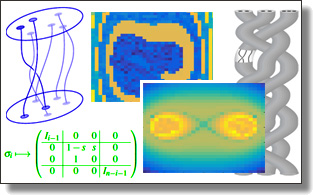
In this paper, we provide a numerical tool to study material coherence from a set of 2D Lagrangian trajectories sampling a dynamical system, i.e., from the motion of passive tracers. We show that eigenvectors of the Burau representation of a topological braid derived from the trajectories have levelsets corresponding to components of the Nielsen--Thurston decomposition of the dynamical system. One can thus detect and identify clusters of space-time trajectories corresponding to coherent regions of the dynamical system by solving an eigenvalue problem. Unlike previous methods, the scalable computational complexity of our braid-based approach allows the analysis of large amounts of trajectories.
|
 |
3D Hodge Decompositions of Edge- and Face-based Vector Fields
Rundong Zhao, Mathieu Desbrun, Guo-Wei Wei, and Yiying Tong
ACM Trans. Graph. (SIGGRAPH Asia), 38(6), Art. 181, 2019. Code available on github.
Abstract:
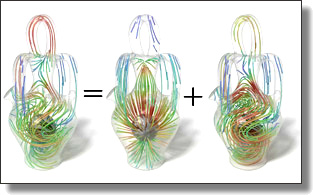
We present a compendium of Hodge decompositions of vector fields on tetrahedral meshes embedded in the 3D Euclidean space. After describing the foundations of the Hodge decomposition in the continuous setting, we describe how to implement a five-component orthogonal decomposition that generically splits, for a variety of boundary conditions, any given discrete vector field expressed as discrete differential forms into two potential fields, as well as three additional harmonic components that arise from the topology or boundary of the domain. The resulting decomposition is proper and mimetic, in the sense that the theoretical dualities on the kernel spaces of vector Laplacians valid in the continuous case (including correspondences to cohomology and homology groups) are exactly preserved in the discrete realm. Such a decomposition only involves simple linear algebra with symmetric matrices, and can thus serve as a basic computational tool for vector field analysis in graphics, electromagnetics, fluid dynamics and elasticity.
|
 |
Material-adapted Refinable Basis Functions for Elasticity Simulation
Jiong Chen, Max Budninskiy, Houman Owhadi, Hujun Bao, Jin Huang, and Mathieu Desbrun.
ACM Trans. Graph. (SIGGRAPH Asia), 38(6), Art. 161, 2019.
Abstract:
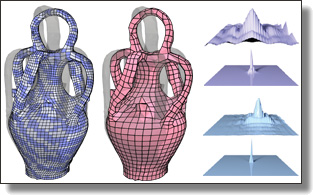
In this paper, we introduce a hierarchical construction of material-adapted refinable basis functions and associated wavelets to offer efficient coarse-graining of linear elastic objects.
While spectral methods rely on global basis functions to restrict the number of degrees of freedom, our basis functions are locally supported; yet, unlike typical polynomial basis functions, they are adapted to the material inhomogeneity of the elastic object to better capture its physical properties and behavior. In particular, they share spectral approximation properties with eigenfunctions, offering a good compromise between computational complexity and accuracy. Their construction involves only linear algebra and follows a fine-to-coarse approach, leading to a block-diagonalization of the stiffness matrix where each block corresponds to an intermediate scale space of the elastic object. Once this hierarchy has been precomputed, we can simulate an object at runtime on very coarse resolution grids and still capture the correct physical behavior, with orders of magnitude speedup compared to a fine simulation. We show on a variety of heterogeneous materials that our approach outperforms all previous coarse-graining methods for elasticity.
|
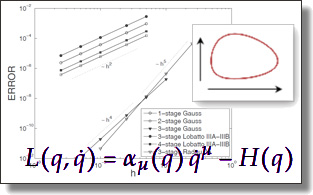 |
Variational partitioned Runge-Kutta methods
for Lagrangians linear in velocities
Tomasz M. Tyranowski and Mathieu Desbrun.
Mathematics 7(9), Art. 861, 2019.
Abstract:
In this paper, we construct higher-order variational integrators for a class of degenerate systems described by Lagrangians that are linear in velocities. We analyze the geometry underlying such systems and develop the appropriate theory for variational integration. Our main observation is that the evolution takes place on the primary constraint and the “Hamiltonian” equations of motion can be formulated as an index-1 differential-algebraic system. We also construct variational Runge–Kutta methods and analyze their properties. The general properties of Runge–Kutta methods
depend on the “velocity” part of the Lagrangian. If the “velocity” part is also linear in the position coordinate, then we show that non-partitioned variational Runge–Kutta methods are equivalent to integration of the corresponding first-order Euler–Lagrange equations, which have the form of a Poisson system with a constant structure matrix, and the classical properties of the Runge–Kutta method are retained. If the “velocity” part is nonlinear in the position coordinate, we observe a reduction of the order of convergence, which is typical of numerical integration of DAEs. We verified
our results through numerical experiments for various dynamical systems.
|
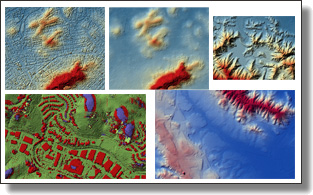 |
Large-scale DTM Generation from Satellite Data
Liuyun Duan, Mathieu Desbrun, Anne Giraud, Frédéric Trastour, Lionel Laurore.
CVPR EarthVision Workshop (IEEE/ISPRS Large Scale Computer Vision for Remote Sensing Imagery), June 2019.
Abstract:
In remote sensing, Digital Terrain Models (DTM) generation is a long-standing problem involving bare-terrain extraction and surface reconstruction to estimate a DTM from a Digital Surface Model (DSM). Most existing methods (including commercial software packages) have difficulty handling large-scale satellite data of inhomogeneous quality and resolution, and often
need an expert-driven manual parameter-tuning process for each geographical type of DSM.
In this paper we propose an automated and versatile DTM generation method from satellite data that is perfectly suited to large-scale applications.
A novel set of feature descriptors based on multiscale morphological analysis are first computed to extract reliable bare-terrain elevations from DSMs. This terrain extraction algorithm is robust to noise and adapts well to local reliefs in both flat and highly mountainous areas. Then, we reconstruct the final DTM mesh using relative coordinates with respect to the sparse elevations previously detected, and induce preservation of geometric details by adapting these coordinates based on local relief attributes. Experiments on worldwide DSMs show the potential of our approach for large-scale DTM generation without parameter tuning. Our system is flexible as well, as it allows for a straightforward integration of multiple external masks (e.g., forest, road line, buildings, lake, etc) to better handle complex cases, resulting in further improvements of the quality of the output DTM.
|
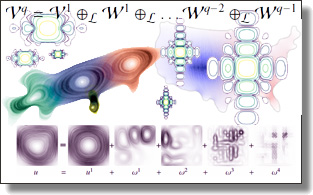 |
Operator-adapted wavelets for finite-element differential forms
Max Budninskiy, Houman Owhadi, and Mathieu Desbrun.
Journal of Computational Physics, 388, pp. 144-177, 2019.
Abstract:
We introduce in this paper an operator-adapted multiresolution analysis for
finite-element differential forms. From a given continuous, linear, bijective,
and self-adjoint positive-definite operator L, a hierarchy of basis functions and
associated wavelets for discrete differential forms is constructed in a fine-tocoarse
fashion and in quasilinear time. The resulting wavelets are L-orthogonal
across all scales, and can be used to derive a Galerkin discretization of the operator
such that its stiffness matrix becomes block-diagonal, with uniformly
well-conditioned and sparse blocks. Because our approach applies to arbitrary
differential p-forms, we can derive both scalar-valued and vector-valued
wavelets block-diagonalizing a prescribed operator. We also discuss the generality
of the construction by pointing out that it applies to various types
of computational grids, offers arbitrary smoothness orders of basis functions
and wavelets, and can accommodate linear differential constraints such as
divergence-freeness. Finally, we demonstrate the benefits of the corresponding
operator-adapted multiresolution decomposition for coarse-graining and
model reduction of linear and non-linear partial differential equations.
|
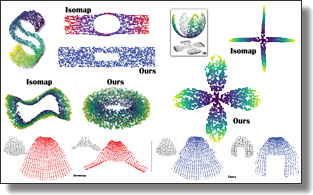 |
Parallel Transport Unfolding: A Connection-based Manifold Learning Approach
Max Budninskiy, Gloria Yin, Leman Feng, Yiying Tong, and Mathieu Desbrun.
SIAM J. Appl. Algebra Geometry, 3(2), pp. 266-291, 2019. Code base available on Github, and the notebook of all examples is here
Abstract:
Manifold learning offers nonlinear dimensionality reduction of high-dimensional datasets. In this paper, we bring geometry processing to
bear on manifold learning by introducing a new approach based on metric connection for generating a quasi-isometric, low-dimensional mapping
from a sparse and irregular sampling of an arbitrary manifold embedded in a high-dimensional space. Geodesic distances of discrete paths over
the input pointset are evaluated through ``parallel transport unfolding'' (PTU) to offer robustness to poor sampling and arbitrary topology.
Our new geometric procedure exhibits the same strong resilience to noise as one of the staples of manifold learning, the Isomap algorithm,
as it also exploits all pairwise geodesic distances to compute a low-dimensional embedding.
While Isomap is limited to geodesically-convex sampled domains, parallel transport unfolding does not suffer from this crippling limitation,
resulting in an improved robustness to irregularity and voids in the sampling.
Moreover, it involves only simple linear algebra, significantly improves the accuracy of all pairwise geodesic distance approximations, and
has the same computational complexity as Isomap. Finally, we show that our connection-based distance estimation can be used for faster
variants of Isomap such as L-Isomap.
|
 |
R-adaptive multisymplectic and variational
integrators
Tomasz M. Tyranowski and Mathieu Desbrun.
Mathematics 7(7), Art. 642, 2019.
Abstract:
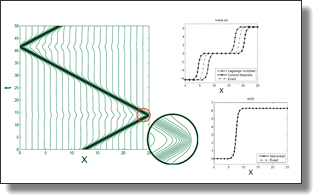
Moving mesh methods (also called r-adaptive methods) are space-adaptive strategies used for the numerical simulation of time-dependent partial differential equations. These methods keep the total number of mesh points fixed during the simulation but redistribute them over time to follow the areas where a higher mesh point density is required. There are a very limited number of moving mesh methods designed for solving field-theoretic partial differential equations, and the numerical analysis of the resulting schemes is challenging. In this paper, we present two ways to construct r-adaptive variational and multisymplectic integrators for (1+1)-dimensional Lagrangian field theories. The first method uses a variational discretization of the physical equations, and the mesh equations are then coupled in a way typical of the existing r-adaptive schemes. The second method treats the mesh points as pseudo-particles and incorporates their dynamics directly into the variational principle. A user-specified adaptation strategy is then enforced through Lagrange multipliers as a constraint on the dynamics of both the physical field and the mesh points. We discuss the advantages and limitations of our methods. Numerical results for the Sine–Gordon equation are also presented.
|
 |
Curved Optimal Delaunay Triangulation
Leman Feng, Pierre Alliez, Laurent Busé, Hervé Delingette, and Mathieu Desbrun.
ACM Trans. Graph., 37(4), Art. 61, 2018. See also Supplemental Material.
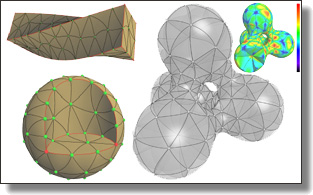
Abstract:
Meshes with curvilinear elements hold the appealing promise of enhanced
geometric flexibility and higher-order numerical accuracy compared to their
commonly-used straight-edge counterparts. However, the generation of
curved meshes remains a computationally expensive endeavor with current
meshing approaches: high-order parametric elements are notoriously difficult
to conform to a given boundary geometry, and enforcing a smooth and
non-degenerate Jacobian everywhere brings additional numerical difficulties
to the meshing of complex domains. In this paper, we propose an extension
of Optimal Delaunay Triangulations (ODT) to curved and graded isotropic
meshes. By exploiting a continuum mechanics interpretation of ODT instead
of the usual approximation theoretical foundations, we formulate a very
robust geometry and topology optimization of Bézier meshes based on a new
simple functional promoting isotropic and uniform Jacobians throughout
the domain. We demonstrate that our resulting curved meshes can adapt to
complex domains with high precision even for a small count of elements
thanks to the added flexibility afforded by more control points and higher
order basis functions.
|
 |
Quadrangulation through Morse-Parameterization Hybridization
Xianzhong Fang, Hujun Bao, Yiying Tong, Mathieu Desbrun, and Jin Huang.
ACM Trans. Graph., 37(4), Art. 92, 2018. See also Supplemental Material, and Thingi10K addendum. Binary code (Linux Mint 19 Cinnamon or Ubuntu 18.04) available too.
Abstract:
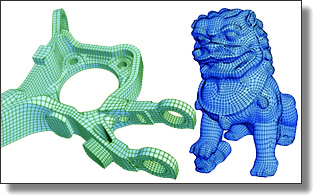
We introduce an approach to quadrilateral meshing of arbitrary triangulated
surfaces that combines the theoretical guarantees of Morse-based approaches
with the practical advantages of parameterization methods. We first construct,
through an eigensolver followed by a few Gauss-Newton iterations,
a periodic four-dimensional vector field that aligns with a user-provided
frame field and/or a set of features over the input mesh. A field-aligned
parameterization is then greedily computed along a spanning tree based on
the Dirichlet energy of the optimal periodic vector field, from which quad
elements are efficiently extracted over most of the surface. The few regions
not yet covered by elements are then upsampled and the first component of
the periodic vector field is used as a Morse function to extract the remaining
quadrangles. This hybrid parameterization- and Morse-based quad meshing
method is not only fast (the parameterization is greedily constructed,
and the Morse function only needs to be upsampled in the few uncovered
patches), but is guaranteed to provide a feature-aligned quad mesh with
non-degenerate cells that closely matches the input frame field over an arbitrary
surface. We show that our approach is much faster than Morse-based
techniques since it does not require a densely tessellated input mesh, and is
significantly more robust than parameterization-based techniques on models
with complex features.
|
 |
Numerical Coarsening using Discontinuous Shape Functions
Jiong Chen, Hujun Bao, Tianyu Wang, Mathieu Desbrun, and Jin Huang.
ACM Trans. Graph., 37(4), Art. 117, 2018.
Abstract:
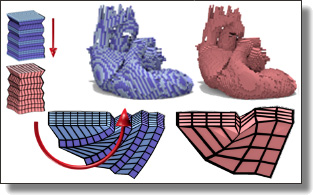
In this paper, an efficient and scalable approach for simulating inhomogeneous
and non-linear elastic objects is introduced. Our numerical coarsening
approach consists in optimizing non-conforming and matrix-valued shape
functions to allow for predictive simulation of heterogeneous materials with
non-linear constitutive laws even on coarse grids, thus saving orders of
magnitude in computational time compared to traditional finite element
computations. The set of local shape functions over coarse elements is carefully
tailored in a preprocessing step to balance geometric continuity and
local material stiffness. In particular, we do not impose continuity of our
material-aware shape functions between neighboring elements to significantly
reduce the fictitious numerical stiffness that conforming bases induce;
however, we enforce crucial geometric and physical properties such as partition
of unity and exact reproduction of representative fine displacements
to eschew the use of discontinuous Galerkin methods. We demonstrate that
we can simulate, with no parameter tuning, inhomogeneous and non-linear
materials significantly better than previous approaches that traditionally try
to homogenize the constitutive model instead.
|
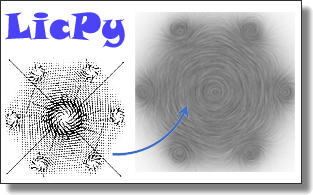 |
LicPy
Dzhelil Rufat.
Standalone Python library, Github, 2018. See also https://dzhelil.info/licpy for the documentation.
Abstract:
LicPy is an implementation in Python of the Line Integral Convolution (LIC) method:
from licpy.lic import runlic
tex = runlic(vx, vy, L)
grey_save(dest, tex)
|
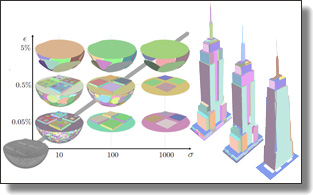 |
Planar Shape Detection at Structural Scales
Hao Fang, Florent Lafarge, and Mathieu Desbrun.
IEEE Conference on Computer Vision and Pattern Recognition (CVPR), 2018, pp. 2965-2973.
Abstract:
Interpreting 3D data such as point clouds or surface meshes depends heavily on the scale of observation. Yet, existing algorithms for shape detection rely on trial-anderror parameter tunings to output configurations representative of a structural scale. We present a framework to automatically extract a set of representations that capture the shape and structure of man-made objects at different key abstraction levels. A shape-collapsing process first generates a fine-to-coarse sequence of shape representations by exploiting local planarity. This sequence is then analyzed to identify significant geometric variations between successive representations through a supervised energy minimization. Our framework is flexible enough to learn how to detect both existing structural formalisms such as the CityGML Levels Of Details, and expert-specified levels of abstraction. Experiments on different input data and classes of manmade objects, as well as comparisons with existing shape detection methods, illustrate the strengths of our approach in terms of efficiency and flexibility.
|
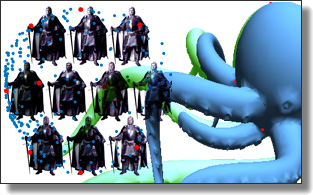 |
Spectral Affine-Kernel Embeddings
Max Budninskiy, Beibei Liu, Yiying Tong, and Mathieu Desbrun.
Symposium on Geometry Processing (won one of the Best Paper awards), Computer Graphics Forum, volume 36, 2017.
Abstract:
In this paper, we propose a controllable embedding method for high- and low-dimensional geometry processing through sparse matrix eigenanalysis. Our approach is equally suitable to perform non-linear dimensionality reduction on big data, or to offer non-linear shape editing of 3D meshes and pointsets. At the core of our approach is the construction of a multi-Laplacian quadratic form that is assembled from local operators whose kernels only contain locally-affine functions. Minimizing this quadratic form provides an embedding that best preserves all relative coordinates of points within their local neighborhoods.
We demonstrate the improvements that our approach brings over existing nonlinear dimensionality reduction methods on a number of datasets, and formulate the first eigen-based as-rigid-as-possible shape deformation technique by applying our affine-kernel embedding approach to 3D data augmented with user-imposed constraints on select vertices.
|
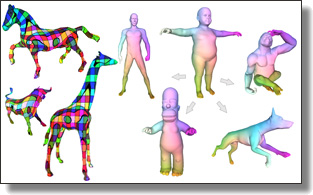 |
Variance-Minimizing Transport Plans for Inter-surface Mapping
Manish Mandad, David Cohen-Steiner, Leif Kobbelt, Pierre Alliez, and Mathieu Desbrun.
ACM Trans. Graph., 36(4), 2017. See also Supplemental Material.
Abstract:
We introduce an efficient computational method for generating dense and low distortion maps between two arbitrary surfaces of same genus. Instead of relying on semantic correspondences or surface parameterization, we directly optimize a variance-minimizing transport plan between two input surfaces that defines an as-conformal-as-possible inter-surface map satisfying a user-prescribed bound on area distortion. The transport plan
is computed via two alternating convex optimizations, and is shown to minimize a generalized Dirichlet energy of both the map and its inverse. Computational efficiency is achieved through a coarse-to-fine approach in diffusion geometry, with Sinkhorn iterations modified to enforce bounded area distortion. The resulting inter-surface mapping algorithm applies to arbitrary shapes robustly, with little to no user interaction.
|
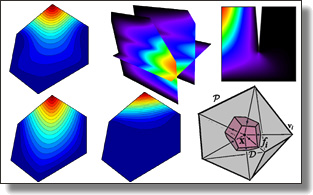 |
Power Coordinates: A Geometric Construction of Barycentric Coordinates on Convex Polytopes
Max Budninskiy, Beibei Liu, Yiying Tong, and Mathieu Desbrun.
ACM Trans. Graph., 35(6), 2016. Supplemental Material: base code.
Abstract:
We present a full geometric parameterization of generalized barycentric coordinates on convex polytopes. We show that these continuous and non-negative coefficients ensuring linear precision can be efficiently and exactly computed through a power diagram of the polytope's vertices and the evaluation point. In particular, we point out that well-known explicit coordinates such as Wachspress, Discrete Harmonic, Voronoi, or Mean Value correspond to simple choices of power weights. We also present examples of new barycentric coordinates, and discuss possible extensions such as power coordinates for non-convex polygons and smooth shapes.
|
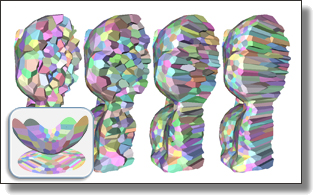 |
Optimal Voronoi Tessellations with Hessian-based Anisotropy
Max Budninskiy, Beibei Liu, Fernando de Goes, Yiying Tong, Pierre Alliez, and Mathieu Desbrun.
ACM Trans. Graph., 35(6), 2016. Supplemental Material.
Abstract:
This paper presents a variational method to generate cell complexes
with local anisotropy conforming to the Hessian of any given convex
function and for any given local mesh density. Our formulation
builds upon approximation theory to offer an anisotropic extension
of Centroidal Voronoi Tessellations which can be seen as a
dual form of Optimal Delaunay Triangulation. We thus refer to the
resulting anisotropic polytopal meshes as Optimal Voronoi Tessellations.
Our approach sharply contrasts with previous anisotropic
versions of Voronoi diagrams as it employs first-type Bregman diagrams,
a generalization of power diagrams where sites are augmented
with not only a scalar-valued weight but also a vectorvalued
shift. As such, our OVT meshes contain only convex cells
with straight edges, and admit an embedded dual triangulation that
is combinatorially-regular. We show the effectiveness of our technique
using off-the-shelf computational geometry libraries.
|
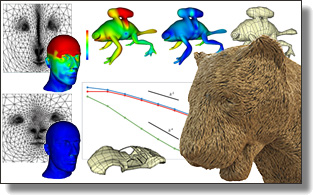 |
Subdivision Exterior Calculus for Geometry Processing
Fernando de Goes, Mathieu Desbrun, Mark Meyer, and Tony DeRose.
ACM Trans. Graph., 35(4), Art. 133, 2016. Supplemental Material part I, part II.
Abstract:
This paper introduces a new computational method to solve differential equations on subdivision surfaces.
Our approach adapts the numerical framework of Discrete Exterior Calculus (DEC) from the polygonal to the subdivision setting by exploiting the refinability of subdivision basis functions. The resulting Subdivision Exterior Calculus (SEC) provides significant improvements in accuracy compared to existing polygonal techniques, while offering exact finite-dimensional analogs of continuum structural identities such as Stokes' theorem and Helmholtz-Hodge decomposition.
We demonstrate the versatility and efficiency of SEC on common geometry processing tasks including parameterization, geodesic distance computation, and vector field design.
|
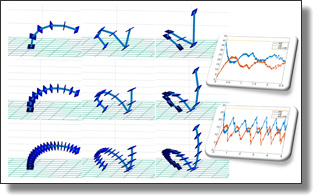 |
A Multisymplectic Integrator for Elastodynamic Frictionless Impact Problems
François Demoures, François Gay-Balmaz, Mathieu Desbrun, Tudor S. Ratiu, and Alejandro M. Aragón.
Computer Methods in Applied Mechanics and Engineering, Volume 315, p. 1025-1052, March 2017.
Abstract:
We present a structure preserving numerical algorithm for the collision of elastic
bodies. Our integrator is derived from a discrete version of the field-theoretic
(multisymplectic) variational description of nonsmooth Lagrangian continuum mechanics,
combined with generalized Lagrange multipliers to handle inequality constraints.
We test the resulting explicit integrator for the longitudinal impact of
two elastic linear bar models, and for the collision of a nonlinear geometrically
exact beam model with a rigid plane. Numerical simulations for various physical
parameters are presented to illustrate the behavior and performance of our
approach.
|
 |
Vector field processing on triangle meshes
Fernando de Goes, Mathieu Desbrun, and Yiying Tong.
Course notes, ACM SIGGRAPH 2016. (powerpoint slides available here)
Abstract:
While scalar fields on surfaces have been staples of geometry processing, the use
of tangent vector fields has steadily grown in geometry processing over the last
two decades: they are crucial to encode both directions and sizing on surfaces
as commonly required in tasks such as texture synthesis, non-photorealistic
rendering, digital grooming, and meshing. There are, however, a variety of discrete
representations of tangent vector fields on triangle meshes, and each approach offers
different trade-offs among simplicity, efficiency, and accuracy depending on the
targeted application.
This course reviews the three main families of discretizations used to design
computational tools for vector field processing on triangle meshes: face-based,
edge-based, and vertex-based representations. In the process of reviewing the
computational tools offered by these representations, we go over a large body of
recent developments in vector field processing in the area of discrete differential
geometry. We also discuss the theoretical and practical limitations of each type of
discretization, and cover increasingly-common extensions such as n-direction and
n-vector fields.
While the course will focus on explaining the key approaches to practical encoding
(including data structures) and manipulation (including discrete operators) of finitedimensional
vector fields, important differential geometric notions will also be
covered: as often in Discrete Differential Geometry, the discrete picture will be
used to illustrate deep continuous concepts such as covariant derivatives, metric
connections, or Bochner Laplacians.
|
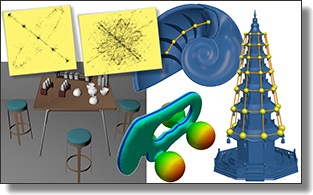 |
Symmetry and Orbit Detection via Lie-Algebra Voting
Zeyun Shi, Pierre Alliez, Mathieu Desbrun, Hujun Bao, and Jin Huang.
Symposium of Geometry Processing (won one of the Best Paper awards), CGF, 26(5):217-227, 2016. See also supplemental material, and hindsight.
Abstract:
In this paper, we formulate an automatic approach to the detection of partial, local, and global symmetries and orbits in arbitrary 3D datasets. We improve upon existing voting-based symmetry detection techniques by leveraging the Lie group structure of geometric transformations. In particular, we introduce a logarithmic mapping that ensures that orbits are mapped to linear subspaces, hence unifying and extending many existing mappings in a single Lie-algebra voting formulation. Compared to previous work, our resulting method offers significantly improved robustness as it guarantees that our symmetry detection of an input model is frame, scale, and reflection invariant. As a consequence, we demonstrate that our approach efficiently and reliably discovers symmetries and orbits of geometric datasets without requiring heavy parameter tuning.
|
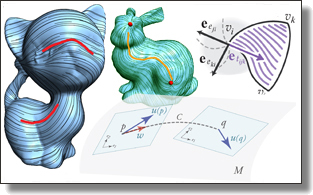 |
Discrete Connection and Covariant Derivative for Vector Field Analysis and Design
Beibei Liu, Yiying Tong, Fernando de Goes, and Mathieu Desbrun.
ACM Trans. Graph, 35(3), Art. 23, 2016.
Abstract:
In this paper, we introduce a discrete definition of connection on simplicial
manifolds, involving closed-form continuous expressions within simplices
and finite rotations across simplices. The finite-dimensional parameters of
this connection are optimally computed by minimizing a quadratic measure
of the deviation to the (discontinuous) Levi-Civita connection induced
by the embedding of the input triangle mesh, or to any metric connection
with arbitrary cone singularities at vertices. From this discrete connection,
a covariant derivative is constructed through exact differentiation, leading
to explicit expressions for local integrals of first-order derivatives (such as
divergence, curl and the Cauchy-Riemann operator), and for L2-based energies
(such as the Dirichlet energy). We finally demonstrate the utility, flexibility,
and accuracy of our discrete formulations for the design and analysis
of vector, n-vector, and n-direction fields.
|
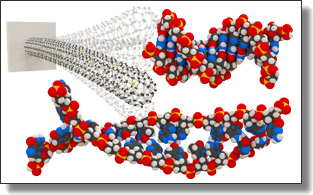 |
A Semi-analytical Approach to Molecular Dynamics
Dominik L. Michels and Mathieu Desbrun.
J. of Computational Physics, Vol. 303, Pages 336-354, December 2015.
Abstract:
Despite numerous computational advances over the last few decades, molecular
dynamics still favors explicit (and thus easily-parallelizable) time integrators for
large scale numerical simulation. As a consequence, computational efficiency in
solving its typically stiff oscillatory equations of motion is hampered by stringent
stability requirements on the time step size. In this paper, we present a semianalytical
integration scheme that others a total speedup of a factor 30 compared
to the Verlet method on typical MD simulation by allowing over three orders of
magnitude larger step sizes. By efficiently approximating the exact integration
of the strong (harmonic) forces of covalent bonds through matrix functions, far
improved stability with respect to time step size is achieved without sacrificing
the explicit, symplectic, time-reversible, or fine-grained parallelizable nature
of the integration scheme. We demonstrate the efficiency and scalability of
our integrator on simulations ranging from DNA strand unbinding and protein
folding to nanotube resonators.
|
 |
Time-Varying Surface Reconstruction of an Actor’s Performance
Ludovic Blache, Mathieu Desbrun, Céline Loscos, and Laurent Lucas.
Advances in Visual Computing, Volume 9474 of Lecture Notes in Computer Science, 92-101, December 2015.
Abstract:
We propose a fully automatic time-varying surface reconstruction
of an actor’s performance captured from a production stage
through omnidirectional video. The resulting mesh and its texture can
then directly be edited in post-production. Our method makes no
assumption on the costumes or accessories present in the recording. We
take as input a raw sequence of volumetric static poses reconstructed
from video sequences acquired in a multi-viewpoint chroma-key studio.
The first frame is chosen as the reference mesh. An iterative approach is
applied throughout the sequence in order to induce a deformation of the
reference mesh for all input frames. At first, a pseudo-rigid transformation
adjusts the pose to match the input visual hull as closely as possible.
Then, local deformation is added to reconstruct fine details. We provide
examples of actors’ performance inserted into virtual scenes, including
dynamic interaction with the environment.
|
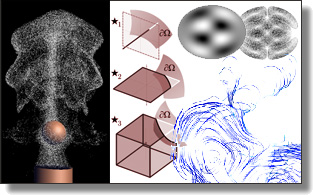 |
Model-Reduced Variational Fluid Simulation
Beibei Liu, Gemma Mason, Julian Hodgson, Yiying Tong, and Mathieu Desbrun.
ACM Trans. Graph. (SIG Asia), 34(6), Art. 244, November 2015.
Abstract:
We present a model-reduced variational Eulerian integrator for incompressible fluids, which combines the efficiency gains of dimension
reduction, the qualitative robustness of coarse spatial and temporal resolutions of geometric integrators, and the simplicity of
sub-grid accurate boundary conditions on regular grids to deal with arbitrarily-shaped domains. At the core of our contributions is a
functional map approach to fluid simulation for which scalar- and vector-valued eigenfunctions of the Laplacian operator can be easily
used as reduced bases. Using a variational integrator in time to preserve liveliness and a simple, yet accurate embedding of the fluid
domain onto a Cartesian grid, our model-reduced fluid simulator can achieve realistic animations in significantly less computational
time than full-scale non-dissipative methods but without the numerical viscosity from which current reduced methods suffer. We also
demonstrate the versatility of our approach by showing how it easily extends to magnetohydrodynamics and turbulence modeling in 2D, 3D and curved domains.
|
 |
Vector field processing on triangle meshes
Fernando de Goes, Mathieu Desbrun, and Yiying Tong.
Course notes, ACM SIGGRAPH Asia 2015.
Abstract:
While scalar fields on surfaces have been staples of geometry processing,
the use of tangent vector fields has steadily grown in geometry processing over the last two decades: they are crucial to encoding directions and sizing on surfaces as commonly required in tasks such as texture synthesis, non-photorealistic rendering, digital grooming, and meshing. There are, however, a variety of discrete representations of tangent vector fields on triangle meshes, and each approach offers different trade-offs among simplicity, efficiency, and accuracy depending on the targeted application.
This course reviews the three main families of discretizations used to design computational tools for vector field processing on triangle meshes: face-based, edge-based, and vertex-based representations. In the process of reviewing the computational tools offered by these representations, we go over a large body of recent developments in vector field processing in the area of discrete differential geometry. We also discuss the theoretical and practical limitations of each type of discretization, and cover increasingly-common extensions such as n-direction and n-vector fields.
While the course will focus on explaining the key approaches to practical encoding and manipulation of finite-dimensional vector fields, important differential geometric notions will also be covered: as often in Discrete Differential Geometry, the discrete picture will be used to illustrate deep continuous concepts such as covariant derivatives, metric connections, or Bochner Laplacians.
|
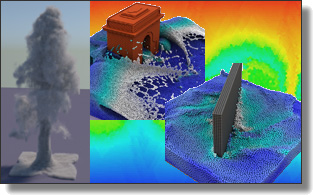 |
Power Particles: An incompressible fluid solver based on power diagrams
Fernando de Goes, Corentin Wallez, Jin Huang, Dmitry Pavlov, and Mathieu Desbrun.
ACM Transactions on Graphics (SIGGRAPH),34(4), Art. 50, 2015. Video part I, part II
Abstract:
This paper introduces a new particle-based approach to incompressible
fluid simulation. We depart from previous Lagrangian methods
by considering fluid particles no longer purely as material points,
but also as volumetric parcels that partition the fluid domain. The
fluid motion is described as a time series of well-shaped power diagrams
(hence the name power particles), offering evenly spaced
particles and accurate pressure computations. As a result, we circumvent
the typical excess damping arising from kernel-based evaluations
of internal forces or density without having recourse to auxiliary
Eulerian grids. The versatility of our solver is demonstrated
by the simulation of multiphase flows and free surfaces.
|
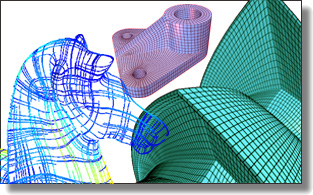 |
Frame Field Generation through Metric Customization
Tengfei Jiang, Xianzhong Fang, Jin Huang, Hujun Bao, Yiying Tong, and Mathieu Desbrun.
ACM Transactions on Graphics (SIGGRAPH), 34(4), Art. 40, 2015.
Abstract:
This paper presents a new technique for frame field generation. As
generic frame fields (with arbitrary anisotropy, orientation, and sizing)
can be regarded as cross fields in a specific Riemannian metric,
we tackle frame field design by first computing a discrete metric on
the input surface that is compatible with a sparse or dense set of input
constraints. The final frame field is then found by computing
an optimal cross field in this customized metric. We propose frame
field design constraints on alignment, size, and skewness at arbitrary
locations on the mesh as well as along feature curves, offering
much improved flexibility over previous approaches. We demonstrate
the advantages of our frame field generation through the automatic
quadrangulation of man-made and organic shapes with controllable
anisotropy, robust handling of narrow surface strips, and
precise feature alignment. We also extend our technique to the design
of n-vector fields.
|
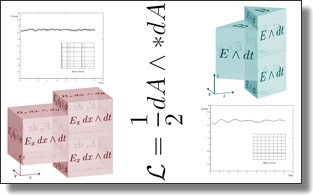 |
Computational Electromagnetism with Variational Integrators and Discrete Differential Forms
Ari Stern, Yiying Tong, Mathieu Desbrun, and Jerrold E. Marsden.
In Geometry, mechanics, and dynamics: the legacy of Jerry Marsden, Fields Institute Communications, 2014.
Abstract:
In this paper, we introduce a general family of variational, multisymplectic numerical methods for solving Maxwell's equations, using discrete differential forms in spacetime. In doing so, we demonstrate several new results, which apply both to some well-established numerical methods and to new methods introduced here. First, we show that Yee's finite-difference time-domain (FDTD) scheme, along with a number of related methods, are multisymplectic and derive from a discrete Lagrangian variational principle. Second, we generalize the Yee scheme to unstructured meshes, not just in space, but in 4-dimensional spacetime. This relaxes the need to take uniform time steps, or even to have a preferred time coordinate at all. Finally, as an example of the type of methods that can be developed within this general framework, we introduce a new asynchronous variational integrator (AVI) for solving Maxwell's equations. These results are illustrated with some prototype simulations that show excellent energy and conservation behavior.
|
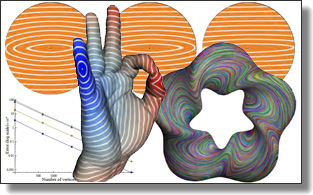 |
Discrete 2-Tensor Fields on Triangulations
Fernando de Goes, Beibei Liu, Max Budninskiy, Yiying Tong, and Mathieu Desbrun.
Symposium on Geometry Processing, CGF, 33(5):13-24, 2014.
Abstract:
Geometry processing has made ample use of discrete representations of tangent vector fields and antisymmetric
tensors (i.e., forms) on triangulations. Symmetric 2-tensors, while crucial in the definition of inner products and
elliptic operators, have received only limited attention. They are often discretized by first defining a coordinate
system per vertex, edge or face, then storing their components in this frame field. In this paper, we introduce a
representation of arbitrary 2-tensor fields on triangle meshes. We leverage a coordinate-free decomposition of
continuous 2-tensors in the plane to construct a finite-dimensional encoding of tensor fields through scalar values
on oriented simplices of a manifold triangulation. We also provide closed-form expressions of pairing, inner
product, and trace for this discrete representation of tensor fields, and formulate a discrete covariant derivative
and a discrete Lie bracket. Our approach extends discrete/finite-element exterior calculus, recovers familiar operators
such as the weighted Laplacian operator, and defines discrete notions of divergence-free, curl-free, and
traceless tensors—thus offering a numerical framework for discrete tensor calculus on triangulations. We finally
demonstrate the robustness and accuracy of our operators on analytical examples, before applying them to the
computation of anisotropic geodesic distances on discrete surfaces.
|
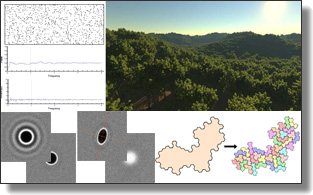 |
Fast Tile-Based Adaptive Sampling with User-Specified Fourier Spectra
Florent Wachtel, Adrien Pilleboue, David Coeurjolly, Katherine Breeden, Gurprit Singh,
Gael Cathelin, Fernando de Goes, Mathieu Desbrun, and Victor Ostromoukhov.
ACM Transactions on Graphics (SIGGRAPH), Vol. 33(4), Art. 56, 2014. (see also Project Page (with code and data), supplementary material, and video)
Abstract:
We introduce a fast tile-based method for adaptive two-dimensional
sampling with user-specified spectral properties. At the core of our
approach is a deterministic, hierarchical construction of self-similar,
equi-area, tri-hex tiles whose centroids have a spatial distribution
free of spurious spectral peaks. A lookup table of sample points,
computed offline using any existing point set optimizer to shape
the samples’ Fourier spectrum, is then used to populate the tiles.
The result is a linear-time, adaptive, and high-quality sampling of
arbitrary density functions that conforms to the desired spectral
distribution, achieving a speed improvement of several orders of
magnitude over current spectrum-controlled sampling methods.
|
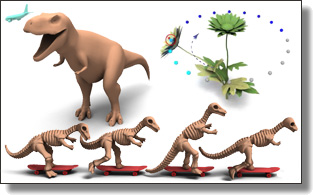 |
Space-Time Editing of Elastic Motion through Material Optimization and Reduction
Siwang Li, Jin Huang, Fernando de Goes, Xiaogang Jin, Hujun Bao, and Mathieu Desbrun.
ACM Transactions on Graphics (SIGGRAPH), Vol. 33(4), Art. 108, 2014. (video)
Abstract:
We present a novel method for elastic animation editing with spacetime
constraints. In a sharp departure from previous approaches,
we not only optimize control forces added to a linearized dynamic
model, but also optimize material properties to better match user
constraints and provide plausible and consistent motion. Our approach
achieves efficiency and scalability by performing all computations
in a reduced rotation-strain (RS) space constructed with
both cubature and geometric reduction, leading to two orders of
magnitude improvement over the original RS method. We demonstrate
the utility and versatility of our method in various applications,
including motion editing, pose interpolation, and estimation
of material parameters from existing animation sequences.
|
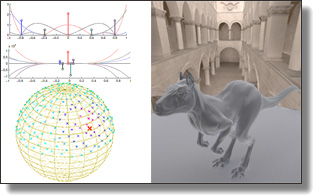 |
A Constructive Theory of Sampling for Image Synthesis using Reproducing Kernel Bases
Christian Lessig, Mathieu Desbrun, and Eugene Fiume.
ACM Transactions on Graphics (SIGGRAPH), Vol. 33(4), Art. 66, 2014 (see also Project Page).
Abstract:
Sampling a scene by tracing rays and reconstructing an image from
such pointwise samples is fundamental to computer graphics. To improve
the efficacy of these computations, we propose an alternative
theory of sampling. In contrast to traditional formulations for image
synthesis, which appeal to nonconstructive Dirac deltas, our theory
employs constructive reproducing kernels for the correspondence
between continuous functions and pointwise samples. Conceptually,
this allows us to obtain a common mathematical formulation of
almost all existing numerical techniques for image synthesis. Practically,
it enables novel sampling based numerical techniques designed
for light transport that provide considerably improved performance
per sample. We exemplify the practical benefits of our formulation
with three applications: pointwise transport of color spectra, projection
of the light energy density into spherical harmonics, and
approximation of the shading equation from a photon map. Experimental
results verify the utility of our sampling formulation, with
lower numerical error rates and enhanced visual quality compared
to existing techniques.
|
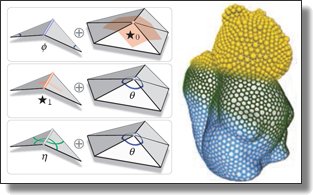 |
Weighted Triangulations for Geometry Processing
Fernando de Goes, Pooran Memari, Patrick Mullen, and Mathieu Desbrun.
ACM Transactions on Graphics, Vol. 33 (3). Art. 28, 2014.
Abstract:
In this paper, we investigate the use of weighted triangulations as discrete, augmented approximations of surfaces for digital geometry processing.
By incorporating a scalar weight per mesh vertex, we introduce a new notion of discrete metric that defines an orthogonal dual structure for arbitrary triangle meshes and thus extends weighted Delaunay triangulations to surface meshes.
We also present alternative characterizations of this primal-dual structure (through combinations of angles, areas, and lengths) and, in the process, uncover closed-form expressions of mesh energies that were previously known in implicit form only.
Finally, we demonstrate how weighted triangulations provide a faster and more robust approach to a series of geometry processing applications, including the generation of well-centered meshes, self-supporting surfaces, and sphere packing.
|
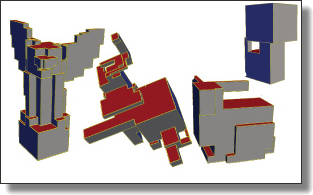 |
ℓ₁-based Construction of Polycube Maps from Complex Shapes
Jin Huang, Tengfei Jiang, Zeyun Shi, Yiying Tong, Hujun Bao, and Mathieu Desbrun.
ACM Transactions on Graphics, Vol. 33(3), Art. 25, 2014.
Abstract:
Polycube maps of triangle meshes have proved useful in a wide range of applications including texture mapping and hexahedral mesh generation.
However, constructing either fully automatically or with limited user control a low-distortion polycube from a detailed surface remains challenging
in practice. We propose a variational method for deforming an input triangle mesh into a polycube shape through minimization of the ℓ₁-norm of the mesh normals, regularized via an as-rigid-as-possible volumetric distortion energy. Unlike previous work, our approach makes no assumption on the
orientation, or on the presence of features in the input model. User-guided control over the resulting polycube map is also offered to increase design
flexibility. We demonstrate the robustness, efficiency and controllability of our method on a variety of examples, and explore applications in hexahedral
remeshing and quadrangulation.
|
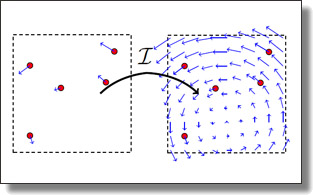 |
On the Coupling Between an Ideal Fluid and Immersed Particles
Henry O. Jacobs, Tudor S. Ratiu, and Mathieu Desbrun.
Physica D, 265(15), pp. 40–56, December 2013.
Abstract:
In this paper we present finite dimensional particle-based models for fluids which respect a number of geometric properties of the Euler equations of motion.
Specifically, we use Lagrange-Poincaré reduction to understand the coupling between a fluid and a set of
Lagrangian particles that are supposed to simulate it. We substitute the use of principal connections in [Cendra et al. 2001] with vector field valued interpolations
from particle velocity data. The consequence of writing evolution equations in terms of
interpolation is two-fold. First, it provides estimates on the error incurred when interpolation is used to derive the
evolution of the system. Second, this form of the equations of motion can inspire a family of particle and hybrid
particle-spectral methods, where the error analysis is "built-in''. We also discuss the influence of other
parameters attached to the particles, such as shape, orientation, or higher-order deformations, and how they can
help with conservation of momenta in the sense of Kelvin's circulation theorem.
|
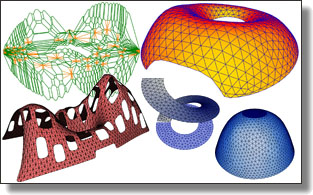 |
On the Equilibrium of Simplicial Masonry Structures
Fernando de Goes, Pierre Alliez, Houman Owhadi, and Mathieu Desbrun
ACM Transactions on Graphics (SIGGRAPH) 32(4), Art. 93, 2013
Abstract:
We present a novel approach for the analysis and design of selfsupporting
simplicial masonry structures. A finite-dimensional formulation
of their compressive stress field is derived, offering a new
interpretation of thrust networks through numerical homogenization
theory. We further leverage geometric properties of the resulting
force diagram to identify a set of reduced coordinates characterizing
the equilibrium of simplicial masonry. We finally derive computational
form-finding tools that improve over previous work in
efficiency, accuracy, and scalability.
|
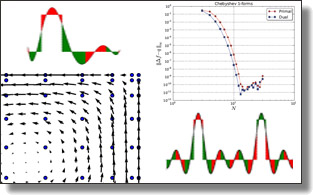 |
The Chain Collocation Method: A Spectrally Accurate Calculus of Forms
Dzhelil Rufat, Gemma Mason, Patrick Mullen, and Mathieu Desbrun.
Journal of Computational Physics, Volume 257(B), Pages 1352-1372, 2014.[Project page]
Abstract:
Preserving in the discrete realm the underlying geometric, topological, and algebraic structures at stake in partial differential equations has proven to be a fruitful guiding principle for numerical methods in a variety of fields such as elasticity, electromagnetism, or fluid mechanics. However, structure-preserving methods have traditionally used spaces of piecewise polynomial basis functions for differential forms. Yet, in many problems where solutions are smoothly varying in space, a spectral numerical treatment is called for. In an effort to provide structure-preserving numerical tools with spectral accuracy on logically rectangular grids over periodic or bounded domains, we present a spectral extension of the discrete exterior calculus (DEC), with resulting computational tools extending well-known collocation-based spectral methods. Its efficient implementation using fast Fourier transforms is provided as well.
|
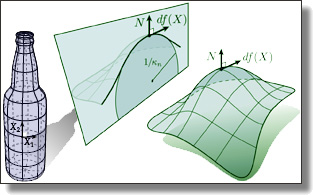 |
Digital Geometry Processing using Discrete Exterior Calculus
Fernando de Goes, Keenan Crane, Peter Schröder, and Mathieu Desbrun
ACM SIGGRAPH'13 Course Notes (see also Keenan's page).
Abstract:
An introduction to geometry processing using discrete exterior calculus (DEC), which provides a simple, flexible, and efficient framework for building a unified geometry-processing platform. The course provides essential mathematical background as well as a large array of real-world examples. It also provides a short survey of the most relevant recent developments in digital geometry processing and discrete differential geometry. Compared to previous SIGGRAPH courses, this course focuses heavily on practical aspects of DEC, with an emphasis on implementation and applications.
The course begins with the core ideas from exterior calculus, in both the smooth and discrete setting. Then it shows how a large number of fundamental geometry-processing tools (smoothing, parameterization, geodesics, mesh optimization, etc) can be implemented quickly, robustly, and efficiently within this single common framework. It concludes with a discussion of recent extensions of DEC that improve efficiency, accuracy, and versatility.
The course notes grew out of the discrete differential geometry course taught over the past five years at the California Institute of Technology, for undergraduates and beginning graduate students in computer science, applied mathematics, and associated fields. The notes also provide guided exercises (both written and coding) that attendees can later use to deepen their understanding of the material.
|
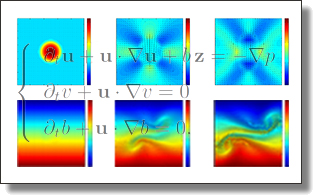 |
Variational Discretization for Rotating Stratified Fluids
Mathieu Desbrun, Evan S. Gawlik, François Gay-Balmaz, and Vladimir Zeitlin
AIMS Discrete & Continuous Systems Series A, 34(2), pp. 477-509, Feb 2014
Abstract. In this paper we develop and test a structure-preserving discretization
scheme for rotating and/or stratified fluid dynamics. The numerical
scheme is based on a finite dimensional approximation of the group of volume
preserving diffeomorphisms and is derived via a discrete version of the Euler-Poincaré variational formulation of rotating
stratified fluids. The resulting variational integrator allows for a discrete version
of Kelvin circulation theorem, is applicable to irregular meshes and, being
symplectic, exhibits excellent long term energy behavior. We then report a
series of preliminary tests for rotating stratified flows in configurations that
are symmetric with respect to translation along one of the spatial directions.
In the benchmark processes of hydrostatic and/or geostrophic adjustments,
these tests show that the slow and fast component of the flow are correctly
reproduced. The harder test of inertial instability is in full agreement with the
common knowledge of the process of development and saturation of this instability,
while preserving energy nearly perfectly and respecting conservation laws.
|
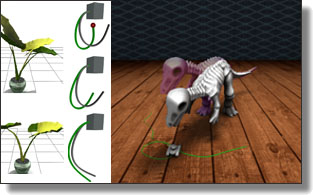 |
Interactive Elastic Motion Editing through Spacetime Position Constraints
Siwang Li, Jin Huang, Mathieu Desbrun. and Xiaogang Jin
Journal of Computer Animation and Virtual Worlds (CASA), 2013
Abstract:
We present an intuitive and interactive approach for motion editing through spacetime constraints
on positions. Given an input motion of an elastic body, our approach enables the user to interactively
edit node positions in order to alter and fine-tune the motion. We formulate our motion
editing as an optimization problem with dynamics constraints to enforce a physically-plausible result.
Through linearization of the editing around the input trajectory, we simplify this constrained optimal
control problem into an unconstrained quadratic optimization. The optimal motion thus becomes
the solution of a dense linear system, which we solve efficiently by applying the adjoint method
in each iteration of a conjugate gradient solver. We demonstrate the efficiency and quality of our
motion editing technique on a series of examples.
|
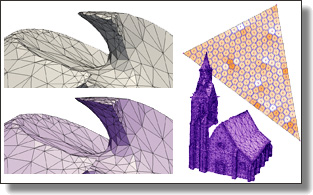 |
Feature-Preserving Surface Reconstruction and Simplification from Defect-Laden Point Sets
Julie Digne, David Cohen-Steiner, Pierre Alliez, Mathieu Desbrun, and Fernando de Goes
Journal of Mathematical Imaging and Vision, Springer, Jan 2013
Abstract:
We introduce a robust and feature-capturing surface reconstruction and simplification method that turns an input point set into a low triangle-count simplicial complex. Our approach starts with a (possibly non-manifold) simplicial complex filtered from a 3D Delaunay triangulation of the input points. This initial approximation is iteratively simplified based on an error metric that measures, through optimal transport, the distance between the input points and the current simplicial complex—both seen as mass distributions. Our approach is shown to exhibit both robustness to noise and outliers, as well as preservation of sharp features and boundaries. Our new feature-sensitive metric between point sets and triangle meshes can also be used as a post-processing tool that, from the smooth output of a reconstruction method, recovers sharp features and boundaries present in the initial point set.
|
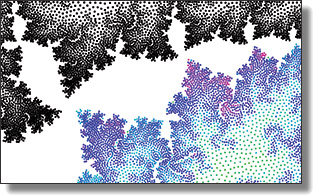 |
Blue Noise through Optimal Transport
Fernando de Goes, Katherine Breeden, Victor Ostromoukhov, and Mathieu Desbrun.
ACM Transactions on Graphics (SIGGRAPH Asia), 2012 [Project page]
Abstract:
We present a fast, scalable algorithm to generate high-quality blue noise point distributions of arbitrary density functions. At its core is a novel formulation of the recently-introduced concept of capacity-constrained Voronoi tessellation as an optimal transport problem. This insight leads to a continuous formulation able to enforce the capacity constraints exactly, unlike previous work. We exploit the variational nature of this formulation to design an efficient optimization technique of point distributions via constrained minimization in the space of power diagrams. Our mathematical, algorithmic, and practical contributions lead to high-quality blue noise point sets with improved spectral and spatial properties.
|
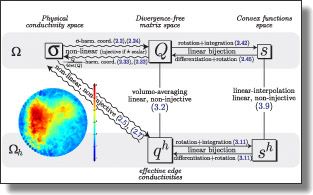 |
Modeling Across Scales: Discrete Geometric Structures in Homogenization and Inverse Homogenization
Mathieu Desbrun, Roger Donaldson, and Houman Owhadi.
In Multiscale Analysis and Nonlinear Dynamics
Reviews of Nonlinear Dynamics and Complexity (Volume 8), Wiley, 2013. See also [arXiv 0904.2601]
Abstract:
Imaging and simulation methods are typically constrained to resolutions much coarser than the scale of physical micro-structures present in body tissues or geological features. Mathematical and numerical homogenization address this practical issue by identifying and computing appropriate spatial averages that result in accuracy and consistency between the macro-scales we observe and the underlying micro-scale models we
assume. Among the various applications benefiting from homogenization, Electric Impedance Tomography (EIT) images the electrical conductivity of a body by measuring electrical potentials consequential to electric currents applied to the exterior of the body. EIT is routinely used in breast cancer detection and cardio-pulmonary imaging, where current flow in fine-scale tissues underlies the resulting coarse-scale images.
In this paper, we introduce a geometric approach for the homogenization (simulation) and inverse homogenization (imaging) of divergence-form elliptic operators with rough conductivity coefficients in dimension two. We show that conductivity coefficients are in one-to-one correspondence with divergence-free matrices and convex functions over the domain. Although homogenization is a non-linear and non-injective operator when applied directly to conductivity coefficients, homogenization becomes a linear interpolation operator over triangulations of the domain when re-expressed using convex functions, and is a volume averaging operator when re-expressed with divergence-free matrices. We explicitly give the transformations which map conductivity coefficients into divergence-free matrices and convex functions, as well as their respective inverses. Using weighted Delaunay triangulations for linearly interpolating convex functions, we apply this geometric framework to obtain a robust homogenization algorithm for arbitrary rough coefficients, extending the global optimality of Delaunay triangulations with respect to a discrete Dirichlet energy to weighted Delaunay triangulations. We then consider inverse homogenization, which is known to be both non-linear and severely ill-posed, but that we can decompose into a linear ill-posed problem and a well-posed non-linear problem. Finally, our new geometric approach to homogenization and inverse homogenization is applied to EIT.
|
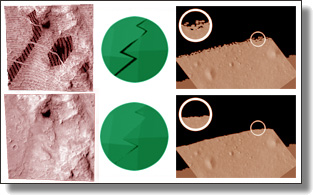 |
Tightening the Precision of Perspective Rendering
Paul Upchurch and Mathieu Desbrun.
Journal of Graphics Tools, Volume 16, Issue 1, 2012.
Abstract:
Precise depth calculation is of crucial importance in graphics rendering. Improving precision raises the quality of all downstream graphical techniques that rely on computed depth (e.g.,, depth buffers, soft and hard shadow maps, screen space ambient occlusion, and 3D stereo projection). In addition, the domain of correctly renderable scenes is expanded by allowing larger far to near plane ratios and smaller depth separation between mesh elements. Depth precision is an ongoing problem as visible artifacts continue to plague applications from interactive games to scientific visualizations despite advances in graphics hardware.
In this paper we present and analyze two methods that can greatly impact visual quality by automatically improving the precision of depth values calculated in a standard perspective divide rendering system such as OpenGL® or DirectX®. The methods are easy to implement and compatible with standard depth value calculations.
|
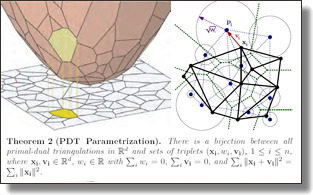 |
Parameterization of Generalized Primal-Dual Triangulations
Pooran Memari, Patrick Mullen, and Mathieu Desbrun.
International Meshing Roundtable, 2011.
Abstract:
Motivated by practical numerical issues in a number of modeling and simulation
problems, we introduce the notion of a compatible dual complex to a
primal triangulation, such that a simplicial mesh and its compatible dual complex
(made out of convex cells) form what we call a primal-dual triangulation.
Using algebraic and computational geometry results, we show that compatible
dual complexes exist only for a particular type of triangulation known as
weakly regular. We also demonstrate that the entire space of primal-dual triangulations,
which extends the well known (weighted) Delaunay/Voronoi duality,
has a convenient, geometric parametrization. We finally discuss how this
parametrization may play an important role in discrete optimization problems
such as optimal mesh generation, as it allows us to easily explore the space of
primal-dual structures along with some important subspaces.
|
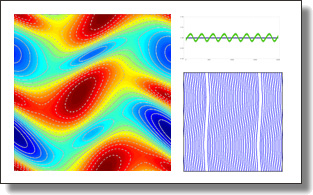 |
Geometric, Variational Discretization of Continuum Theories
Evan Gawlik, Patrick Mullen, Dmitry Pavlov, Jerrold E. Marsden, and Mathieu Desbrun.
Physica D: Nonlinear Phenomena, 240(21), 1724-1760, 2011.
Abstract:
This study derives geometric, variational discretizations of continuum theories arising in fluid dynamics, magnetohydrodynamics (MHD), and the dynamics of complex fluids. A central role in these discretizations is played by the geometric formulation of fluid dynamics, which views solutions to the governing equations for perfect fluid flow as geodesics on the group of volume-preserving diffeomorphisms of the fluid domain. Inspired by this framework, we construct a finite-dimensional approximation to the diffeomorphism group and its Lie algebra, thereby permitting a variational temporal discretization of geodesics on the spatially discretized diffeomorphism group. The extension to MHD and complex fluid flow is then made through an appeal to the theory of Euler-Poincaré systems with advection, which provides a generalization of the variational formulation of ideal fluid flow to fluids with one or more advected parameters. Upon deriving a family of structured integrators for these systems, we test their performance via a numerical implementation of the update schemes on a cartesian grid. Among the hallmarks of these new numerical methods are exact preservation of momenta arising from symmetries, automatic satisfaction of solenoidal constraints on vector fields, good long-term energy behavior, robustness with respect to the spatial and temporal resolution of the discretization, and applicability to irregular meshes.
|
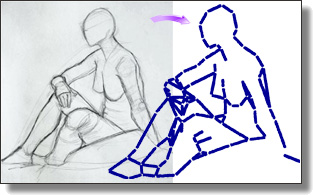 |
An Optimal Transport Approach to Robust Reconstruction and Simplification of 2D Shapes
Fernando de Goes, David Cohen-Steiner, Pierre Alliez, and Mathieu Desbrun.
Symposium on Geometry Processing, 2011.
Abstract:
We propose a robust 2D shape reconstruction and simplification algorithm which takes as input a defect-
laden point set with noise and outliers. We introduce an optimal-transport driven approach where the
input point set, considered as a sum of Dirac measures, is approximated by a simplicial complex
considered as a sum of uniform measures on 0- and 1-simplices. A fine-to-coarse scheme is devised
to construct the resulting simplicial complex through greedy decimation of a Delaunay triangulation of
the input point set. Our method performs well on a variety of examples ranging from line drawings to
grayscale images, with or without noise, features, and boundaries.
|
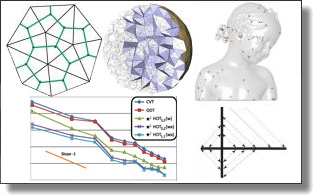 |
HOT: Hodge-Optimized Triangulations
Patrick Mullen, Pooran Memari, Fernando de Goes, Mathieu Desbrun.
Transactions on Graphics (SIGGRAPH) 2011.
Abstract:
We introduce Hodge-optimized triangulations (HOT), a family of well-shaped primal-dual pairs of complexes designed for fast and accurate computations in computer graphics. Previous work most commonly employs barycentric or circumcentric duals; while barycentric duals guarantee that the dual of each simplex lies within the simplex, circumcentric duals are often preferred due to the induced orthogonality between primal and dual complexes. We instead promote the use of weighted duals (power diagrams). They allow greater flexibility in the location of
dual vertices while keeping primal-dual orthogonality, thus providing a valuable extension to the usual choices of dual by only adding one additional scalar per primal vertex. Furthermore, we introduce a family of functionals on pairs of complexes that we derive from bounds on the errors induced by diagonal Hodge stars, commonly used in discrete computations. The minimizers of these functionals, called HOT meshes, are shown to be generalizations of Centroidal Voronoi Tesselations and Optimal Delaunay Triangulations, and to provide increased accuracy and flexibility for a variety of computational purposes.
|
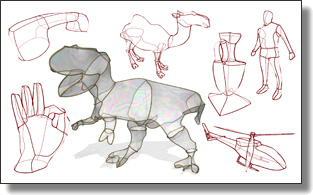 |
Exoskeleton: Curve Network Abstraction for 3D Shapes
F. de Goes, S. Goldenstein, M. Desbrun, L. Velho.
Computer & Graphics, 35(1), February 2011, 112-121.
Abstract:
In this paper, we introduce the concept of an exoskeleton as a new abstraction of arbitrary shapes that succinctly conveys both
the perceptual and the geometric structure of a 3D model. We extract exoskeletons via a principled framework that combines
segmentation and shape approximation. Our method starts from a segmentation of the shape into perceptually relevant parts and
then constructs the exoskeleton using a novel extension of the Variational Shape Approximation method. Benefits of the exoskeleton abstraction to graphics applications such as simplification and chartification are presented.
|
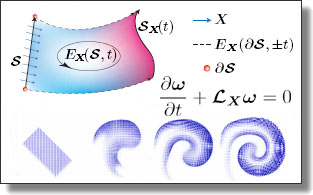 |
Discrete Lie Advection of Differential Forms
P. Mullen, A. McKenzie, D. Pavlov, L. Durant, Y. Tong, E. Kanso, J. E. Marsden, and M. Desbrun.
Found. Comput. Math., 11, pp. 131–149, 2011.
Abstract:
In this paper, we present a numerical technique for performing Lie advection of arbitrary differential forms. Leveraging advances in high-resolution finite volume methods for scalar hyperbolic conservation laws, we first discretize the interior product (also called~\emph{contraction}) through integrals over Eulerian approximations of extrusions. This, along with Cartan's homotopy formula and a discrete exterior derivative, can then be used to derive a discrete Lie derivative. The usefulness of this operator is demonstrated through the numerical advection of scalar fields and 1-forms on regular grids.
|
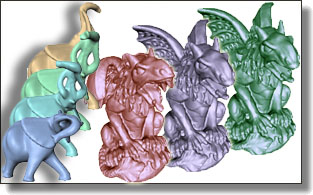 |
Interactive Shape Interpolation through Controllable Dynamic Deformation
J. Huang, Y. Tong, K. Zhou, H. Bao and M. Desbrun.
IEEE Trans. Vis. Comp. Graph., 17(7), pp. 983–992, 2011.
Abstract:
In this paper, we introduce an interactive approach to generate physically-based shape interpolation between poses. We extend linear modal analysis to offer an efficient and robust numerical technique to generate physically-plausible dynamics even for very large deformation. Our method also provides a rich set of intuitive editing tools with real-time feedback, including control over vibration frequencies, amplitudes, and damping of the resulting interpolation sequence. We demonstrate the versatility of our approach through a series of complex dynamic shape interpolations.
|
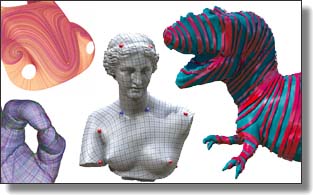 |
Trivial Connections on Discrete Surfaces
K. Crane, M. Desbrun, and P.Schröder.
Symposium on Geometry Processing (Computer Graphics Forum), 2010.
(see also Keenan's project page for code and pictures; SGP Best Paper award)
Abstract:
This paper presents a straightforward algorithm for constructing connections on discrete surfaces that are as smooth as possible everywhere but on a set of isolated singularities with given index. We compute these connections by solving a single linear system built from standard operators. The solution can be used to design rotationally symmetric direction fields with user-specified singularities and directional constraints.
|
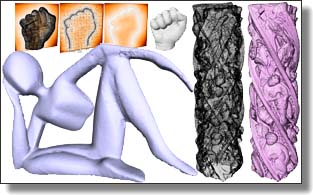 |
Signing the Unsigned: Robust Surface Reconstruction from Raw Pointsets
P. Mullen, F. de Goes, M. Desbrun, D. Cohen-Steiner, and P. Alliez.
Symposium on Geometry Processing (to appear in Computer Graphics Forum), 2010.
Abstract:
We propose a modular framework for robust 3D reconstruction from unorganized, unoriented, noisy, and outlierridden
geometric data. We gain robustness and scalability over previous methods through an unsigned distance
approximation to the input data followed by a global stochastic signing of the function. An isosurface reconstruction
is finally deduced via a sparse linear solve. We show with experiments on large, raw, geometric datasets that
this approach is scalable while robust to noise, outliers, and holes. The modularity of our approach facilitates
customization of the pipeline components to exploit specific idiosyncracies of datasets, while the simplicity of each
component leads to a straightforward implementation.
|
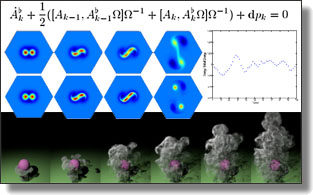 |
Structure-Preserving Discretization of Incompressible Fluids
D. Pavlov, P. Mullen, Y. Tong, E. Kanso, J. E. Marsden, and M. Desbrun.
Physica D: Nonlinear Phenomena
Volume 240, Issue 6, 1 March 2011, Pages 443-458.
Abstract:
The geometric nature of Euler fluids has been clearly identified and extensively studied over the years, culminating with Lagrangian and Hamiltonian descriptions of fluid dynamics where the configuration space is defined as the volume-preserving diffeomorphisms, and Kelvin's circulation theorem is viewed as a consequence of Noether's theorem associated with the particle relabeling symmetry of fluid mechanics. However computational approaches to fluid mechanics have been largely derived from a numerical-analytic point of view, and are rarely designed with structure preservation in mind, and often suffer from spurious numerical artifacts such as energy and circulation drift. In contrast, this paper geometrically derives discrete equations of motion for fluid dynamics from first principles in a purely Eulerian form. Our approach approximates the group of volume-preserving diffeomorphisms using a finite dimensional Lie group, and associated discrete Euler equations are derived from a variational principle with non-holonomic constraints. The resulting discrete equations of motion yield a structure-preserving time integrator with good long-term energy behavior and for which an exact discrete Kelvin's circulation theorem holds.
|
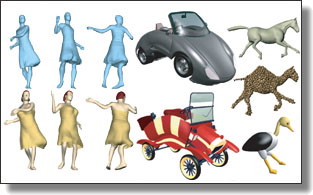 |
Deformation Transfer to Multi-Component Objects
Kun Zhou, Weiwei Xu, Yiying Tong, and Mathieu Desbrun.
Proceedings of Eurographics 2010. (movie)
Abstract:
We present a simple and effective algorithm to transfer deformation between surface meshes with multiple components.
The algorithm automatically computes spatial relationships between components of the target object, builds
correspondences between source and target, and finally transfers deformation of the source onto the target while
preserving cohesion between the target’s components. We demonstrate the versatility of our approach on various complex models.
|
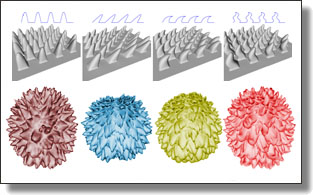 |
Height and Tilt Geometric Texture
Vedrana Andersen, Mathieu Desbrun, J. Andreas Bærentzen, and Henrik Aanæs.
Internation Symposium on Visual Computing 2009.
Lecture Notes in Computer Science, SpringerVerlag.
Abstract:
We propose a new intrinsic representation of geometric texture over triangle meshes. Our approach extends the conventional height
field texture representation by incorporating displacements in the tangential plane in the form of a normal tilt. This texture representation
offers a good practical compromise between functionality and simplicity: it can efficiently handle and process geometric texture too complex to be represented as a height field, without having recourse to full blown mesh editing algorithms. The height-and-tilt representation proposed here is fully intrinsic to the mesh, making texture editing and animation (such as bending or waving) intuitively controllable over arbitrary base mesh. We also provide simple methods for texture extraction and transfer using our height-and-field representation.
|
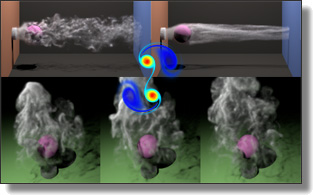 |
Energy-preserving Integrators for Fluid Animation (corrected version; the pseudocode was missing a term)
Patrick Mullen, Keenan Crane, Dmitry Pavlov, Yiying Tong, and Mathieu Desbrun.
ACM Transactions on Graphics (SIGGRAPH), 28(3), 2009.
Abstract:
Numerical viscosity has long been a problem in fluid animation.
Existing methods suffer from intrinsic artificial dissipation and often
apply complicated computational mechanisms to combat such
effects. Consequently, dissipative behavior cannot be controlled
or modeled explicitly in a manner independent of time step size,
complicating the use of coarse previews and adaptive-time stepping
methods. This paper proposes simple, unconditionally stable,
fully Eulerian integration schemes with no numerical viscosity that
are capable of maintaining the liveliness of fluid motion without
recourse to corrective devices. Pressure and fluxes are solved efficiently
and simultaneously in a time-reversible manner on simplicial
grids, and the energy is preserved exactly over long time scales
in the case of inviscid fluids. These integrators can be viewed as an
extension of the classical energy-preserving Harlow-Welch / Crank-
Nicolson scheme to simplicial grids.
|
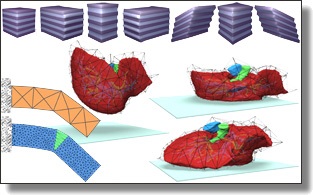 |
Numerical Coarsening of Inhomogeneous Elastic Materials
Lily Kharevych, Patrick Mullen, Houman Owhadi, and Mathieu Desbrun.
ACM Transactions on Graphics (SIGGRAPH), 28(3), 2009.
Abstract:
We propose an approach for efficiently simulating elastic objects
made of non-homogeneous, non-isotropic materials. Based on recent
developments in homogenization theory, a methodology is introduced
to approximate a deformable object made of arbitrary fine
structures of various linear elastic materials with a dynamically-similar
coarse model. This numerical coarsening of the material
properties allows for simulation of fine, heterogeneous structures
on very coarse grids while capturing the proper dynamics of the
original dynamical system, thus saving orders of magnitude in
computational time. Examples including inhomogeneous and/or
anisotropic materials can be realistically simulated in realtime with
a numerically-coarsened model made of a few mesh elements.
|
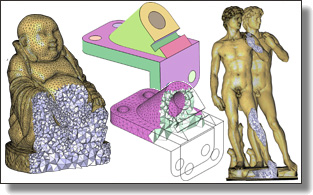 |
Interleaving Delaunay Refinement and Optimization
for Practical Isotropic Tetrahedron Mesh Generation
Jane Tournois, Camille Wormser, Pierre Alliez, and Mathieu Desbrun.
ACM Transactions on Graphics (SIGGRAPH), 28(3), 2009.
Abstract:
We present a practical approach to isotropic tetrahedral meshing of
3D domains bounded by piecewise smooth surfaces. Building upon
recent theoretical and practical advances, our algorithm interleaves
Delaunay refinement and mesh optimization to generate quality
meshes that satisfy a set of user-defined criteria. This interleaving is
shown to be more conservative in number of Steiner point insertions
than refinement alone, and to produce higher quality meshes than
optimization alone. A careful treatment of boundaries and their
features is presented, offering a versatile framework for designing
smoothly graded tetrahedral meshes.
|
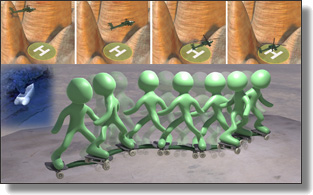 |
Lie Group Integrators for Animation and Control of Vehicles
Marin Kobilarov, Keenan Crane, and Mathieu Desbrun.
ACM Trans. Graph., 28(2), Art. 16, 2009.
(see also Keenan's project page for movies).
Abstract:
This paper is concerned with the animation and control of vehicles with complex dynamics such as helicopters, boats, and cars. Motivated by recent developments in discrete geometric mechanics we develop a general framework for integrating the dynamics of holonomic and nonholonomic vehicles by preserving their state-space geometry and motion invariants. We demonstrate that the resulting integration schemes are superior to standard methods in numerical robustness and efficiency, and can be applied to many types of vehicles. In addition, we show how to use this framework in an optimal control setting to automatically compute accurate and realistic motions for arbitrary user-specified constraints.
|
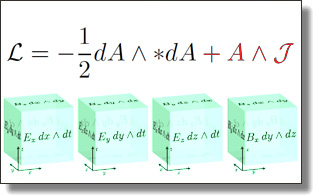 |
Variational Integrators for Maxwell's Equations with Sources
Ari Stern, Yiying Tong, Mathieu Desbrun, and Jerrold E. Marsden.
In Progress in Electromagnetics Research Symposium (PIERS), Vol. 4, No. 7, 711-715, 2008.
Abstract:
In recent years, two important techniques for geometric numerical discretization
have been developed. In computational electromagnetics, spatial discretization has been
improved by the use of mixed finite elements and discrete differential forms. Simultaneously, the
dynamical systems and mechanics communities have developed structure-preserving time
integrators, notably variational integrators that are constructed from a Lagrangian action principle.
Here, we discuss how to combine these two frameworks to develop variational spacetime
integrators for Maxwell's equations. Extending our previous work, we also show here how to incorporate
free sources of charge and current.
|
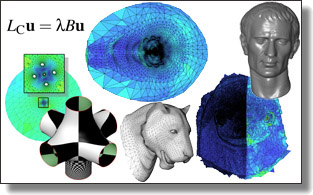 |
Spectral Conformal Parameterization
Patrick Mullen, Yiying Tong, Pierre Alliez, Mathieu Desbrun.
Symposium of Geometry Processing, 2008.
Abstract:
We present a spectral approach to automatically and efficiently obtain discrete free-boundary conformal parameterizations of triangle mesh patches, without the common artifacts due to positional constraints on vertices and without undue bias introduced by sampling irregularity. High-quality parameterizations are computed through a constrained minimization of a discrete weighted conformal energy by finding the largest eigenvalue/eigenvector of a generalized eigenvalue problem involving sparse, symmetric matrices. We demonstrate that this novel and robust approach improves on previous linear techniques both quantitatively and qualitatively.
|
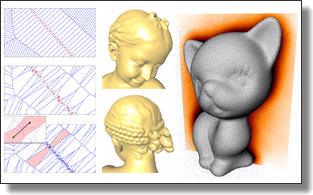 |
Voronoi-based Variational Reconstruction of Unoriented Point Sets
Pierre Alliez, David Cohen-Steiner, Yiying Tong, and Mathieu Desbrun.
Symposium on Geometry Processing, pp. 39-48, 2007.
Abstract:
We introduce an algorithm for reconstructing watertight surfaces from unoriented point sets. Using the Voronoi diagram of the input point set, we deduce a tensor field whose principal axes and eccentricities locally represent respectively the most likely direction of the normal to the surface, and the confidence in this direction estimation. An implicit function is then computed by solving a generalized eigenvalue problem such that its gradient is most aligned with the principal axes of the tensor field, providing a best-fitting isosurface reconstruction. Our approach possesses a number of distinguishing features. In particular, the implicit function optimization provides resilience to noise, adjustable fitting to the data, and controllable smoothness of the reconstructed surface. Finally, the use of simplicial meshes (possibly restricted to a thin crust around the input data) and (an)isotropic Laplace operators renders the numerical treatment simple and robust.
|
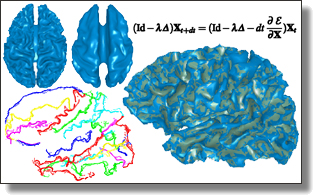 |
Generalized Surface Flows for Deformable Registration and Cortical Matching
Ilya Eckstein, Anand A. Joshi, C.C. Jay Kuo, Richard Leahy, and Mathieu Desbrun.
Proceedings of MICCAI, 2007.
Abstract:
Despite being routinely required in medical applications, deformable surface registration is notoriously difficult due to large intersubject variability and complex geometry of most medical datasets. We present a general and flexible deformable matching framework based on generalized surface flows that efficiently tackles these issues through tailored deformation priors and multiresolution computations. The value of our approach over existing methods is demonstrated for automatic and user-guided cortical registration.
|
 |
Generalized Surface Flows for Mesh Processing
Ilya Eckstein, Jean-Philippe Pons, Yiying Tong, C.C. Jay Kuo, and Mathieu Desbrun.
Symposium on Geometry Processing, pp. 183-192 2007.
Abstract:
Geometric flows are ubiquitous in mesh processing.
Curve and surface evolutions based on functional minimization
have been used in the context of surface diffusion, denoising,
shape optimization, minimal surfaces, and geodesic
paths to mention a few. Such gradient flows are nearly always,
yet often implicitly, based on the canonical L2
inner product of vector fields. In this paper, we point out that
changing this inner product provides a simple,
powerful, and untapped approach to extend current flows. We
demonstrate the value of such a norm alteration
for regularization and volume-preservation purposes and in the
context of shape matching, where deformation
priors (ranging from rigid motion to articulated motion) can be
incorporated into a gradient flow to drastically
improve results. Implementation details, including a differentiable
approximation of the Hausdorff distance between
irregular meshes, are presented.
|
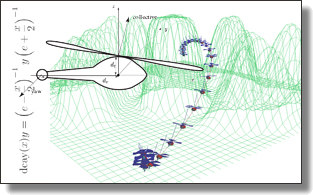 |
A Discrete Geometric Optimal Control Framework for Systems with Symmetries
Marin Kobilarov, Mathieu Desbrun, Jerrold E. Marsden, and Gaurav S. Sukhatme.
Proceedings of Robotics: Science and Systems, 2007.
Abstract:
This paper studies the optimal motion control of
mechanical systems through a discrete geometric approach. At
the core of our formulation is a discrete Lagrange-d’Alembert-Pontryagin
variational principle, from which are derived discrete
equations of motion that serve as constraints in our optimization
framework. We apply this discrete mechanical approach to
holonomic systems with symmetries and, as a result, geometric
structure and motion invariants are preserved. We illustrate our
method by computing optimal trajectories for a simple model of
an air vehicle flying through a digital terrain elevation.
|
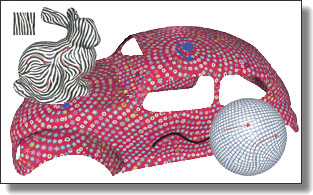 |
Design of Tangent Vector Fields (version with no movies here)
Matthew Fisher, Peter Schröder, Mathieu Desbrun, and Hugues Hoppe.
ACM Trans. on Graphics (SIGGRAPH) 26(3), art. 56, 2007.
Abstract:
Tangent vector fields are an essential ingredient in controlling
surface appearance for applications ranging from anisotropic
shading to texture synthesis and non-photorealistic rendering. To
achieve a desired effect one is typically interested in smoothly
varying fields that satisfy a sparse set of user-provided constraints.
Using tools from Discrete Exterior Calculus, we present a simple
and efficient algorithm for designing such fields over arbitrary
triangle meshes. By representing the field as scalars over mesh
edges (i.e., discrete 1-forms), we obtain an intrinsic, coordinate-free
formulation in which field smoothness is enforced through
discrete Laplace operators. Unlike previous methods, such a formulation
leads to a linear system whose sparsity permits efficient
pre-factorization. Constraints are incorporated through weighted
least squares and can be updated rapidly enough to enable interactive
design, as we demonstrate in the context of anisotropic
texture synthesis.
|
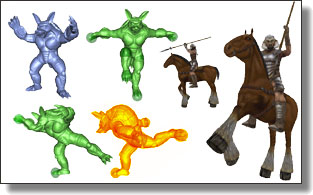 |
Mesh Puppetry: Cascading Optimization of Mesh Deformation with Inverse Kinematics
Xiaohan Shi, Kun Zhou, Yiying Tong, Mathieu Desbrun, Hujun Bao, and Baining Guo.
ACM Trans. on Graphics (SIGGRAPH) 26(3), art. 81, 2007. (movie)
Abstract:
We present mesh puppetry, a variational framework for detail-preserving
mesh manipulation through a set of high-level, intuitive,
and interactive design tools. Our approach builds upon traditional
rigging by optimizing skeleton position and vertex weights in an
integrated manner. New poses and animations are created by specifying
a few desired constraints on vertex positions, balance of the
character, length and rigidity preservation, joint limits, and/or
self-collision avoidance. Our algorithm then adjusts the skeleton and
solves for the deformed mesh simultaneously through a novel cascading
optimization procedure, allowing realtime manipulation of
meshes with 50K+ vertices for fast design of pleasing and realistic
poses. We demonstrate the potential of our framework through an
interactive deformation platform and various applications such as
deformation transfer and motion retargeting.
|
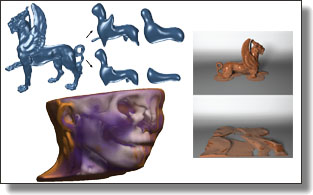 |
A Variational Approach to Eulerian Geometry Processing
Patrick Mullen, Alexander McKenzie, Yiying Tong, and Mathieu Desbrun
ACM Trans. on Graphics (SIGGRAPH) 26(3), art. 66, 2007. (movie)
Abstract:
We present a purely Eulerian framework for geometry processing of
surfaces and foliations. Contrary to current Eulerian methods used
in graphics, we use conservative methods and a variational interpretation,
offering a unified framework for routine surface operations
such as smoothing, offsetting, and animation. Computations are performed
on a fixed volumetric grid without recourse to Lagrangian
techniques such as triangle meshes, particles, or path tracing. At the
core of our approach is the use of the Coarea Formula to express
area integrals over isosurfaces as volume integrals. This enables
the simultaneous processing of multiple isosurfaces, while a single
interface can be treated as the special case of a dense foliation. We
show that our method is a powerful alternative to conventional geometric
representations in delicate cases such as the handling of
high-genus surfaces, weighted offsetting, foliation smoothing of
medical datasets, and incompressible fluid animation.
|
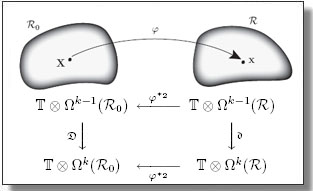 |
On the Geometric Character of Stress in Continuum Mechanics
Eva Kanso, Marino Arroyo, Yiying Tong, Arash Yavari, Jerrold E. Marsden, and Mathieu Desbrun
Z. angew. Math. Phys. 58 (2007) 843-856.
Abstract:
This paper shows that the stress field in the classical theory of continuum mechanics
may be taken to be a covector-valued differential two-form. The balance laws and other fundamental
laws of continuum mechanics may be neatly rewritten in terms of this geometric stress. A
geometrically attractive and covariant derivation of the balance laws from the principle of energy
balance in terms of this stress is presented.
|
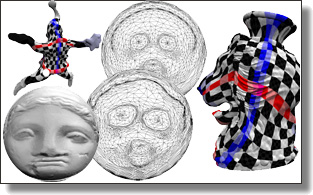 |
Unconstrained Spherical Parameterization
Ilja Friedel, Peter Schröder, and Mathieu Desbrun
Journal of Graphics Tools, 12(1), pp. 17-26, 2007.
(see also: ACM SIGGRAPH Technical Sketch '05).
Abstract:
We introduce a novel approach for the construction of spherical
parameterizations based on energy minimization. The energies are
derived in a general manner from classic formulations well
known in the planar parameterization setting (e.g., conformal, Tutte,
area, stretch energies, etc), based on the following principles:
the energy should (1) be a measure of spherical triangles; (2) treat
energies independently of the triangle location on the sphere; and
(3) converge to the continuous energy \emph{from above} under
refinement. Based on these considerations we give a very simple
non-linear modification of standard formulas that fulfills all these
requirements. The method avoids the usual collapse of flat
energies when they are transferred to the spherical setting without
additional constraints (e.g., fixing three or more vertices). Our
unconstrained energy minimization problem is amenable to the
use of standard solvers. Consequently the implementation effort is
minimal while still achieving excellent robustness and performance
through the use of widely available numerical minimization software.
|
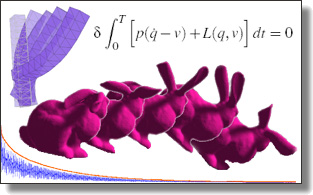 |
Geometric, Variational Integrators for Computer Animation
L. Kharevych, Weiwei, Y. Tong, E. Kanso, J. E. Marsden, P. Schröder, and Mathieu Desbrun
ACM/EG Symposium on Computer Animation 2006, pp. 43-51
Abstract:
We present a general-purpose numerical scheme for time integration of Lagrangian dynamical systems—an important
computational tool at the core of most physics-based animation techniques. Several features make this
particular time integrator highly desirable for computer animation: it numerically preserves important invariants,
such as linear and angular momenta; the symplectic nature of the integrator also guarantees a correct energy
behavior, even when dissipation and external forces are added; holonomic constraints can also be enforced quite
simply; finally, our simple methodology allows for the design of high-order accurate schemes if needed. Two key
properties set the method apart from earlier approaches. First, the nonlinear equations that must be solved during
an update step are replaced by a minimization of a novel functional, speeding up time stepping by more than a
factor of two in practice. Second, the formulation introduces additional variables that provide key flexibility in the
implementation of the method. These properties are achieved using a discrete form of a general variational principle
called the Pontryagin-Hamilton principle, expressing time integration in a discrete geometric manner analog
in spirit to geometric modeling techniques to design smooth curves or surfaces. We demonstrate the applicability
of our integrators to the simulation of non-linear elasticity with implementation details.
|
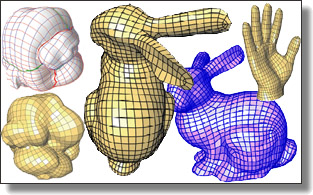 |
Designing Quadrangulations with Discrete Harmonic Forms
Yiying Tong, Pierre Alliez, David Cohen-Steiner, and Mathieu Desbrun
ACM/EG Symposium on Geometry Processing 2006, pp. 201-210
Abstract:
We introduce a framework for quadrangle meshing of discrete
manifolds. Based on discrete differential forms, our method
hinges on extending the discrete Laplacian operator (used
extensively in modeling and animation) to allow for line
singularities and singularities with fractional indices. When
assembled into a singularity graph, these line singularities are
shown to considerably increase the design flexibility of quad
meshing. In particular, control over edge alignments and mesh
sizing are unique features of our novel approach. Another appeal
of our method is its robustness and scalability from a numerical
viewpoint: we simply solve a sparse linear system to generate
a pair of piecewise-smooth scalar fields whose isocontours form a
pure quadrangle tiling, with no T-junctions.
|
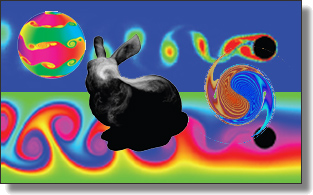 |
Stable, Circulation-Preserving, Simplicial Fluids
Sharif Elcott, Yiying Tong, Eva Kanso, Peter Schröder, and Mathieu Desbrun
ACM Transactions on Graphics, 26(1), art. 4, Jan. 2007.(movie)
Abstract:
Visual quality, low computational cost, and numerical stability are foremost goals in computer
animation. An important ingredient in achieving these goals is the conservation of fundamental
motion invariants. For example, rigid and deformable body simulation benefits greatly from
conservation of linear and angular momenta. In the case of fluids, however, none of the current
techniques focuses on conserving invariants, and consequently, they often introduce a visually
disturbing numerical diffusion of vorticity. Visually just as important is the resolution of complex
simulation domains. Doing so with regular (even if adaptive) grid techniques can be computationally
delicate. In this paper, we propose a novel technique for the simulation of fluid flows.
It is designed to respect the defining differential properties, i.e., the conservation of circulation
along arbitrary loops as they are transported by the flow. Consequently, our method offers several
new and desirable properties: arbitrary simplicial meshes (triangles in 2D, tetrahedra in 3D) can
be used to define the fluid domain; the computations involved in the update procedure are efficient
due to discrete operators with small support; and it preserves discrete circulation avoiding
numerical diffusion of vorticity.
|
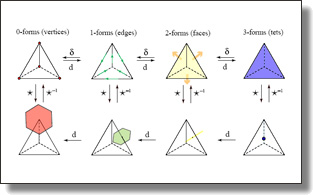 |
Discrete Differential Forms for Computational Modeling
Mathieu Desbrun, Eva Kanso, and Yiying Tong
Chapter in ACM SIGGRAPH'05 and '06 Course
Notes on Discrete Differential Geometry (revised)
Abstract:
The emergence of computers as an essential tool in scientific research
has shaken the very foundations of differential modeling.
Indeed, the deeply-rooted abstraction of smoothness, or differentiability,
seems to inherently clash with a computer’s ability of storing
only finite sets of numbers. While there has been a series of computational
techniques that proposed discretizations of differential
equations, the geometric structures they are supposed to simulate
are often lost in the process.
|
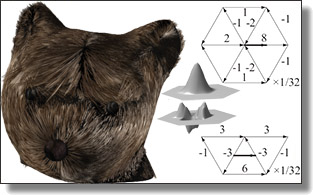 |
Edge Subdivision Schemes and the Construction of Smooth Vector Fields
Ke Wang, Weiwei, Yiying Tong, Mathieu Desbrun, and Peter Schröder
ACM Trans. on Graphics (SIGGRAPH '06), 25(3), pp. 1041-1048
Abstract:
Vertex- and face-based subdivision schemes are now routinely
used in geometric modeling and computational science, and
their primal/dual relationships are well studied. In this paper,
we interpret these schemes as defining bases for discrete differential
0- resp. 2-forms, and complete the picture by introducing
edge-based subdivision schemes to construct the missing bases
for discrete differential 1-forms. Such subdivision schemes map
scalar coefficients on edges from the coarse to the refined mesh
and are intrinsic to the surface. Our construction is based on
treating vertex-, edge-, and face-based subdivision schemes as
a joint triple and enforcing that subdivision commutes with the
topological exterior derivative. We demonstrate our construction
for the case of arbitrary topology triangle meshes. Using
Loop’s scheme for 0-forms and generalized half-box splines for 2-
forms results in a unique generalized spline scheme for 1-forms,
easily incorporated into standard subdivision surface codes. We
also provide corresponding boundary stencils. Once a metric is
supplied, the scalar 1-form coefficients define a smooth tangent
vector field on the underlying subdivision surface. Design of tangent
vector fields is made particularly easy with this machinery
as we demonstrate.
|
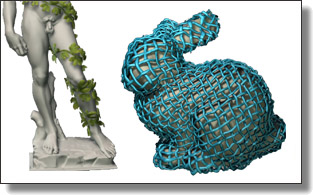 |
Mesh Quilting For Geometric Texture Synthesis
K. Zhou, X. Huang, X. Wang, Y. Tong, M. Desbrun, B. Guo, H.-Y. Sheum
In ACM Trans. on Graphics (SIGGRAPH '06). 25(3), pp. 690-697
Abstract:
We introduce mesh quilting, a geometric texture synthesis algorithm
in which a 3D texture sample given in the form of a triangle
mesh is seamlessly applied inside a thin shell around an arbitrary
surface through local stitching and deformation. We show that
such geometric textures allow interactive and versatile editing and
animation, producing compelling visual effects that are difficult to
achieve with traditional texturing methods. Unlike pixel-based image
quilting, mesh quilting is based on stitching together 3D geometry
elements. Our quilting algorithm finds corresponding geometry
elements in adjacent texture patches, aligns elements through
local deformation, and merges elements to seamlessly connect texture
patches. For mesh quilting on curved surfaces, a critical issue
is to reduce distortion of geometry elements inside the 3D space of
the thin shell. To address this problem we introduce a low-distortion
parameterization of the shell space so that geometry elements can
be synthesized even on very curved objects without the visual distortion
present in previous approaches. We demonstrate how mesh
quilting can be used to generate convincing decorations for a wide
range of geometric textures.
|
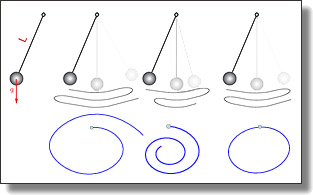 |
Discrete Geometric Mechanics for Variational Integrators (A Primer for CS)
Ari Stern, and Mathieu Desbrun
Chapter in ACM SIGGRAPH'06 Course
Notes on Discrete Differential Geometry
Abstract:
In this chapter, we present a geometric---instead of a
traditional numerical-analytic---approach to the problem of time
integration. Geometry at its most abstract is the study of
symmetries and their associated invariants. Variational approaches
based on such notions are commonly used in geometric modeling and
discrete differential geometry. Here we will treat mechanics in a
similar way. Indeed, the very essence of a mechanical system is
characterized by its symmetries and invariants. Thus
preserving these symmetries and invariants (e.g., certain momenta)
into the discrete computational setting is of paramount importance
if one wants discrete time integration to properly capture the
underlying continuous motion. Motivated by the well-known
variational and geometric nature of most dynamical systems, we
review the use of discrete variational principles as a way to
derive robust, and accurate time integrators.
|
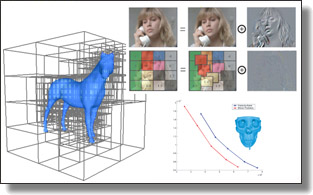 |
Compression of Time Varying Isosurfaces
Ilya Eckstein, Mathieu Desbrun, and C.C. Jay Kuo
In Graphics Interface '06, pp. 99-105
Abstract:
Compressing sequences of complex time-varying surfaces as generated
by medical instrumentations or complex physical simulations
can be extremely challenging: repeated topology changes during
the surface evolution render most of the previous techniques for
compression of time-varying surfaces inefficient or impractical. In
order to provide a viable solution, we propose a new approach based
upon an existing isosurface compression technique designed for static
surfaces. We exploit temporal coherence of the data by adopting
the paradigm of block-based motion prediction developed in video
coding and extending it using local surface registration. The resulting
prediction errors across frames are treated as a static isosurface
and encoded progressively using an adaptive octree-based scheme.
We also exploit local spatiotemporal patterns through context-based
arithmetic coding. Fine-grain geometric residuals are encoded separately
with user-specified precision. The other design choices
made to handle large datasets are detailed.
|
 |
Discrete Differential Geometry: An Applied Introduction
Eitan Grinspun, Peter Schröder, and Mathieu Desbrun
ACM SIGGRAPH'05 Course Notes (see also: DDG Forum).
Slides: Calculus on Meshes,
Discrete Differential Fluids, and
Meshing
Abstract:
This volume documents the full day course Discrete Differential Geometry: An Applied Introduction presented
at SIGGRAPH ’05 on July 31st, 2005. These notes supplement the lectures given by Mathieu Desbrun,
Eitan Grinspun, and Peter Schr¨oder, compiling contributions from: Pierre Alliez, Alexander Bobenko,
David Cohen-Steiner, Sharif Elcott, Eva Kanso, Liliya Kharevych, Adrian Secord, John M. Sullivan, Yiying
Tong, Mariette Yvinec.
|
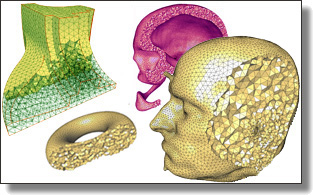 |
Variational Tetrahedral Meshing
Pierre Alliez, David Cohen-Steiner, Mariette Yvinec,
and Mathieu Desbrun
ACM Trans. on Graphics (SIGGRAPH '05), 24(3), pp. 617-625
Abstract:
In this paper, a novel Delaunay-based variational approach to
isotropic tetrahedral meshing is presented. To achieve both robustness
and efficiency, we minimize a simple mesh-dependent energy
through global updates of both vertex positions and connectivity.
As this energy is known to be the L1 distance between an isotropic
quadratic function and its linear interpolation on the mesh, our minimization
procedure generates well-shaped tetrahedra. Mesh design
is controlled through a gradation smoothness parameter and selection
of the desired number of vertices. We provide the foundations
of our approach by explaining both the underlying variational principle
and its geometric interpretation. We demonstrate the quality
of the resulting meshes through a series of examples.
|
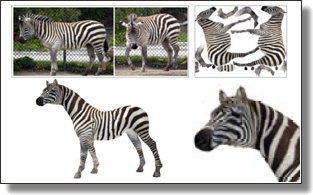 |
TextureMontage: Seamless Texturing of Surfaces From Multiple Images
Kun Zhou, Xi Wang, Yiying Tong,
Mathieu Desbrun, Baining Guo, and H.-Y. Shum
ACM Trans. on Graphics (SIGGRAPH '05), 24(3), pp. 1148-1155.
Abstract:
We propose a technique, called TextureMontage, to seamlessly map
a patchwork of texture images onto an arbitrary 3D model. A texture
atlas can be created through the specification of a set of correspondences
between the model and any number of texture images.
First, our technique automatically partitions the mesh and the images,
driven solely by the choice of feature correspondences. Most
charts will then be parameterized over their corresponding image
planes through the minimization of a distortion metric based on
both geometric distortion and texture mismatch across patch boundaries
and images. Lastly, a surface texture inpainting technique is
used to fill in the remaining charts of the surface with no corresponding
texture patches. The resulting texture mapping satisfies
the (sparse or dense) user-specified constraints while minimizing
the distortion of the texture images and ensuring a smooth transition
across the boundaries of different mesh patches.
|
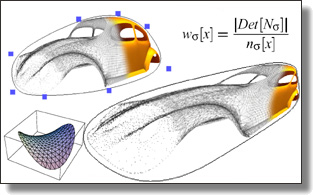 |
Barycentric Coordinates for Convex Sets
Joe Warren, Scott Schaefer, Anil Hirani,
and Mathieu Desbrun
Advances in Computational Mathematics 27(3) (2007), 319--338.
Abstract:
Convex Sets
Barycentric coordinates are one of the most basic mathematical tools in graphics,
as well as in many computational sciences. Although the formulas for simplices
(triangles, tetrahedra and so on) are widely known and
routinely used, there has been no satisfactory extension of these to arbitrary convex
polytopes despite a plethora of potential applications. In this paper, we propose a
simple, computationally convenient formula of a canonical form of barycentric coordinates.
These functions are rational, smooth and of low degree. Next, we extend
the formulas for convex polytopes to smooth, convex functions. Finally, we
present an application of barycentric coordinates to free-form deformation.
|
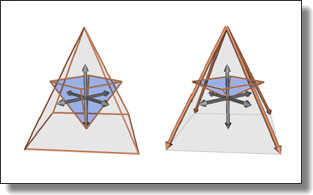 |
A Geometric Construction of
Coordinates for Convex Polyhedra using Polar Duals
Tao Ju, Scott Schaefer, Joe Warren, and Mathieu Desbrun
ACM SIGGRAPH/EG Symposium of Geometry Processing 2005, pp. 181-186.
Abstract:
A fundamental problem in geometry processing is that of expressing a point inside a convex polyhedron as a
combination of the vertices of the polyhedron. Instances of this problem arise often in mesh parameterization and
3D deformation. A related problem is to express a vector lying in a convex cone as a non-negative combination
of edge rays of this cone. This problem also arises in many applications such as planar graph embedding and
spherical parameterization. In this paper, we present a unified geometric construction for building these weighted
combinations using the notion of polar duals. We show that our method yields a simple geometric construction
for Wachspress’s barycentric coordinates, as well as for constructing Colin de Verdière matrices from convex
polyhedra—a critical step in Lovasz’s method with applications to parameterizations.
|
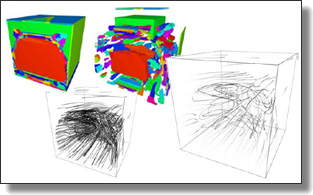 |
Vector Field Analysis and Visualization through Variational Clustering
Alexander McKenzie, Santiago Lombeyda, Mathieu Desbrun
EG - IEEE VGTC Symposium on Visualization (2005), 1-–7.
Abstract:
Scientific computing is an increasingly crucial component of research in various disciplines. Despite its potential,
exploration of the results is an often laborious task, owing to excessively large and verbose datasets output by these simulation runs. Several approaches have been proposed to analyze, classify, and simplify such data to facilitate
an informative visualization and deeper understanding of the underlying system. However, traditional methods
leave much room for improvement. In this article we investigate the visualization of large vector fields, departing
from accustomed processing algorithms by casting vector field simplification as a variational partitioning problem.
Adopting an iterative strategy, we introduce the notion of vector “proxies” to minimize the distortion error of our
simplification by clustering the dataset into multiple best-fitting characteristic regions. This error driven
approach can be performed with respect to various similarity metrics, offering a convenient set of tools to design
clear and succinct representations of high dimensional datasets. We illustrate the benefits of such tools through
visualization experiments of three-dimensional vector fields.
|
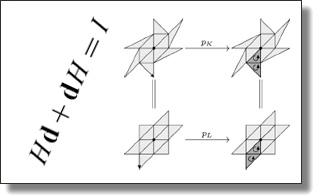 |
Discrete Poincaré Lemma
Mathieu Desbrun, Melvin Leok, Jerrold E. Marsden
Applied Numerical Mathematics 53 (2005) 231–248.
Abstract:
This paper proves a discrete analogue of the Poincaré lemma in the context of a discrete exterior calculus based
on simplicial cochains. The proof requires the construction of a generalized cone operator as the geometric cone of a simplex cannot, in general, be interpreted as a chain in the simplicial complex. The
corresponding cocone operatorcan be shown to be a homotopy operator, and this yields
the discrete Poincaré lemma. The generalized cone operator is a combinatorial operator that can be
constructed for any simplicial complex that can be grown by a process of local augmentation.
In particular, regular triangulations and tetrahedralizations in R^2 and R^3 are presented, for which
the discrete Poincaré lemma is globally valid.
|
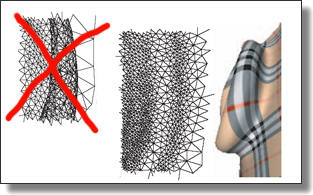 |
Geodesics-based One-to-One Parameterization of 3D Triangle Meshes
Haeyoung Lee, Yiying Tong, and Mathieu Desbrun
IEEE Multimedia journal, Volume 12,
Issue 1, Jan.-March 2005, 27--33.
Abstract:
Digital geometry is a new data type for multimedia applications. To
foster the use of 3D geometry, we introduce a piecewise linear
parameterization of 3D surfaces that we can use for texture mapping, morphing,
remeshing, and geometry imaging. Our method
guarantees one-to-one mapping without foldovers in
a geometrically intuitive way.
|
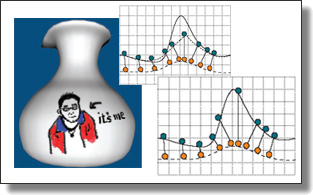 |
A Haptic-Rendering
Technique Based on Hybrid Surface Representation
Laehyun Kim, Gaurav Sukhatme, and Mathieu Desbrun
IEEE Computer Graphics and Applications
Volume 24, Number 2, March/April 2004, 66--75.
Abstract:
Our novel haptic rendering technique using a hybrid surface representation
addresses conventional limitations in haptic displays.
|
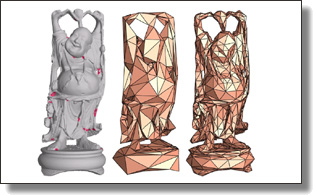 |
Removing Excess Topology From Isosurfaces
Zoë Wood, Hugues
Hoppe, Mathieu Desbrun and Peter Schröder
ACM Trans. on Graphics, 23(2), pp. 190 - 203, April 2004
Abstract:
Many high-resolution surfaces are created through isosurface extraction from volumetric representations, obtained by 3D photography, CT, or MRI. Noise inherent in the acquisition process can lead to geometrical and topological errors. Reducing geometrical errors during reconstruction is well studied. However, isosurfaces often contain many topological errors in the form of tiny handles. These nearly invisible artifacts hinder subsequent operations like mesh simplification, remeshing, and parametrization. In this article we present a practical method for removing handles in an isosurface. Our algorithm makes an axis-aligned sweep through the volume to locate handles, compute their sizes, and selectively remove them. The algorithm is designed to facilitate out-of-core execution. It finds the handles by incrementally constructing and analyzing a Reeb graph. The size of a handle is measured by a short non-separating cycle. Handles are removed robustly by modifying the volume rather than attempting “mesh surgery.” Finally, the volumetric modifications are spatially localized to preserve geometrical detail. We demonstrate topology simplification on several complex models, and show its benefits for subsequent surface processing.
|
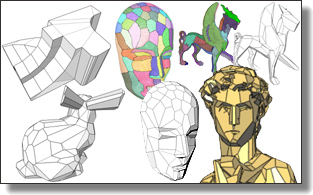 |
Variational Shape Approximation
David Cohen-Steiner, Pierre Alliez,
and Mathieu Desbrun
ACM Trans. of Graphics (SIGGRAPH '04).
Abstract:
Achieving efficiency in mesh processing often demands that overly
verbose 3D datasets be reduced to more concise, yet faithful representations.
Despite numerous applications ranging from geometry
compression to reverse engineering, concisely capturing the geometry
of a surface remains a tedious task. In this paper, we present
both theoretical and practical contributions that result in a novel and
versatile framework for geometric approximation of surfaces. We
depart from the usual strategy by casting shape approximation as
a variational geometric partitioning problem. Using the concept of
geometric proxies, we drive the distortion error down through repeated
clustering of faces into best-fitting regions. Our approach is
entirely discrete and error-driven, and does not require parameterization
or local estimations of differential quantities. We also introduce
a new metric based on normal deviation, and demonstrate its
superior behavior at capturing anisotropy.
|
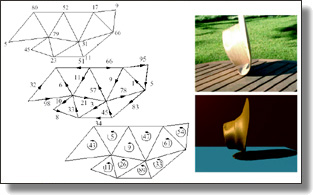 |
Discrete Exterior Calculus for Variational Problems in Computer Graphics and Vision
Mathieu Desbrun, Anil Hirani,
and Jerrold E. Marsden
In the 42nd IEEE Conference on Decision and Control Proceedings (CDC '03), 42, 4902-4907.
Abstract:
This paper demonstrates how discrete exterior
calculus tools may be useful in computer vision and graphics.
A variational approach provides a link with mechanics. [This is an invited paper, gathering different pieces of work already published]
|
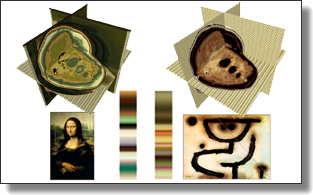 |
Interactive Extraction of High-Frequency Aesthetically-Coherent Colormaps
Santiago V. Lombeyda and Mathieu Desbrun
Technical report, Caltech, 2003.
Abstract:
Color transfer functions (i.e. colormaps) exhibiting a high
frequency luminosity component have proven to be useful in the
visualization of data where feature detection or iso-contours
recognition is essential. Having these colormaps also display a
wide range of color and an aesthetically pleasing composition
holds the potential to further aid image understanding and
analysis. However producing such colormaps in an efficient
manner with current colormap creation tools is difficult. We
hereby demonstrate an interactive technique for extracting
colormaps from artwork and pictures. We show how the rich and
careful color design and dynamic luminance range of an existing
image can be gracefully captured in a colormap and be utilized
effectively in the exploration of complex datasets.
|
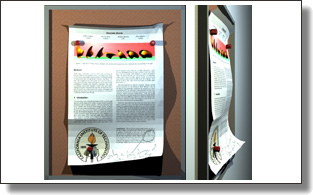 |
Discrete Shells
Eitan Grinspun, Anil Hirani,
Mathieu Desbrun and Peter Schröder
In ACM/Eurographics Symposium of Computer Animation 2003
Abstract:
In this paper we introduce a discrete shell model describing the behavior of thin flexible structures, such as hats, leaves, and aluminum cans, which are characterized by a curved undeformed configuration. Previously such
models required complex continuum mechanics formulations and correspondingly complex algorithms. We show that a simple shell model can be derived geometrically for triangle meshes and implemented quickly by modifying a
standard cloth simulator. Our technique convincingly simulates a variety of curved objects with materials ranging from paper to metal, as we demonstrate with several examples including a comparison of a real and simulated falling hat.
Check out the videos on the Multires Group website
|
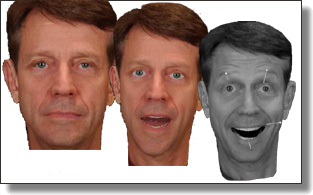 |
Learning Controls for Blend Shape Based Realistic Facial Animation
Pushkar Joshi, Wen Tien,
Mathieu Desbrun and Fred Pighin
In ACM/Eurographics Symposium of Computer Animation 2003
Abstract:
Blend shape animation is the method of choice for keyframe facial animation: a set of
blend shapes (key facial expressions) are used to define a linear space of facial expressions.
However, in order to capture a significant range of complexity of human expressions,
blend shapes need to be segmented into smaller regions where key
idiosyncracies of the face being animated are present. Performing this segmentation by hand
requires skill and a lot of time. In this paper, we propose an automatic, physically-motivated
segmentation that learns the controls and parameters directly from the set of blend shapes.
We show the usefulness and efficiency of this technique for both,
motion-capture animation and keyframing. We also provide a rendering algorithm to enhance
the visual realism of a blend shape model.
Movies (divX):
Capture,
Result,
Editing1,
Editing2,
Editing3.
|
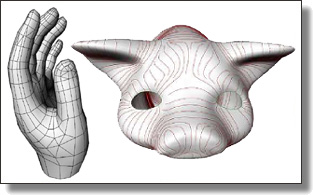 |
Anisotropic
Polygonal Remeshing
Pierre Alliez,
David Cohen-Steiner, Olivier Devillers, Bruno Lévy,
and Mathieu Desbrun
In ACM SIGGRAPH '03 / ACM TOG
Abstract:
In this paper, we propose a novel polygonal remeshing technique
that exploits a key aspect of surfaces: the intrinsic anisotropy of
natural or man-made geometry. In particular, we use curvature directions
to drive the remeshing process, mimicking the lines that
artists themselves would use when creating 3d models from scratch.
After extracting and smoothing the curvature tensor field of an input
geometry, lines of minimum and maximum curvatures are used to
determine adequate edges for the remeshed version in anisotropic
regions, while spherical regions are simply point-sampled since
there is no natural direction of symmetry locally. As a result our
technique generates polygon meshes mainly composed of quads
on anisotropic regions, and of triangles in spherical regions. Our
approach provides the flexibility to produce meshes ranging from
isotropic to anisotropic, from coarse to dense, and from uniform to
curvature adapted.
|
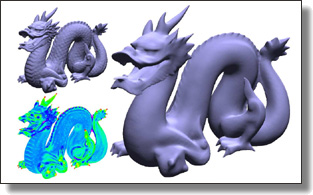 |
Non-iterative,
Feature-Preserving Mesh Smoothing
Thouis R. Jones,
Frédo Durand, and Mathieu Desbrun
In ACM SIGGRAPH '03 / ACM TOG
Abstract:
With the increasing use of geometry scanners to create 3D models,
there is a rising need for fast and robust mesh smoothing to
remove inevitable noise in the measurements. While most previous
work has favored diffusion-based iterative techniques for feature-preserving
smoothing, we propose a radically different approach,
based on robust statistics and local first-order predictors of the surface.
The robustness of our local estimates allows us to derive a
non-iterative feature-preserving filtering technique applicable to arbitrary
"triangle soups". We demonstrate its simplicity of implementation
and its efficiency, which makes it an excellent solution
for smoothing large, noisy, and non-manifold meshes.
|
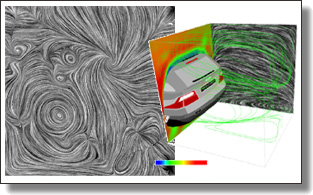 |
Discrete
Multiscale Vector Field Decomposition
Yiying Tong, Santiago Lombeyda,
Anil Hirani, Mathieu Desbrun
In ACM SIGGRAPH '03 / ACM TOG
Abstract:
While 2D and 3D vector fields are ubiquitous in computational sciences,
their use in graphics is often limited to regular grids, where
computations are easily handled through finite-difference methods.
In this paper, we propose a set of simple and accurate tools for
the analysis of 3D discrete vector fields on arbitrary tetrahedral
grids. We introduce a variational, multiscale decomposition of vector
fields into three intuitive components: a divergence-free part, a
curl-free part, and a harmonic part. We show how our discrete approach
matches its well-known smooth analog, called the Helmotz-Hodge
decomposition, and that the resulting computational tools
have very intuitive geometric interpretation. We demonstrate the
versatility of these tools in a series of applications, ranging from
data visualization to fluid and deformable object simulation.
|
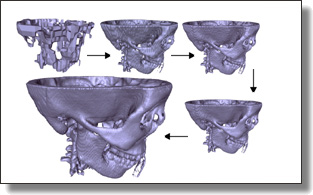 |
Progressive
Encoding of Complex Isosurfaces
(see our executable)
Haeyoung Lee,
Mathieu Desbrun, and Peter Schröder
In ACM SIGGRAPH '03 / ACM TOG
Abstract:
We present a progressive encoding technique specifically designed
for complex isosurfaces. It achieves better rate distortion performance
than all standard mesh coders, and even improves on all previous single rate
isosurface coders. Our novel algorithm handles isosurfaces with or without
sharp features, and deals gracefully with high topologic and geometric
complexity. The inside/outside function of the volume data is
progressively transmitted through the use of an adaptive octree,
while a local frame based encoding is used for the fine level
placement of surface samples.
Local patterns in topology and local smoothness in geometry
are exploited by context-based arithmetic encoding,
allowing us to achieve an average of 6.3 bits per vertex (b/v) at
very low distortion. Of this rate only 0.69 b/v are dedicated to
connectivity data: this improves by 18% over the best previous
single rate isosurface encoder.
|
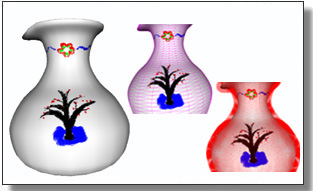 |
Haptic Editing for Decoration and Material Properties
Laehyun Kim,
Gaurav S. Sukhatme and Mathieu Desbrun
Accepted in 11th Symposium on Haptic Interfaces for Virtual Environment and Teleoperator Systems, IEEE Computer Society, 2003
Abstract: In this paper, we explore haptic editing as a powerful way
to enhance haptic realism. Building upon the framework of a
previous implicit-based haptic technique, our haptic decoration
technique allows the user to first paint directly on 3D models,
and then to sense the thickness variation due to the added paint.
Meanwhile, material editing permits the user to edit and feel
local material properties such as friction and stiffness in a
natural way. In addition, we extended the initial haptic model to
support some novel features including a magnetic surface
attraction that forces the tool tip to stick to the surface of
complex models.
|
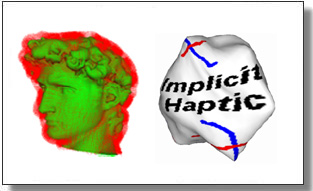 |
An
Implicit-based Haptic Rendering Technique (go to
the haptics page to download
library)
Laehyun Kim, Anna Kyrikou,
Gaurav S. Sukhatme and Mathieu Desbrun
In IEEE/RSJ IROS 2002 Proceedings
Abstract: We present a novel
haptic rendering technique. Building upon previous work, we propose a haptic
model based on a volumetric description of the geometry of an object. Unlike
previous volumetric approaches, we also find a virtual contact point on
the surface in order to derive a penalty force that is consistent with
the real geometry of the object, without introducing force discontinuity.
We also demonstrate that other surface properties such as friction and
texture can be added elegantly. The resulting technique is fast (1000 Hz
refresh rate) and can handle large geometry models on low-end computers.
|
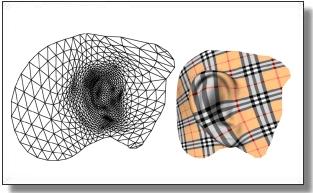 |
Intrinsic
Parameterizations of Surface Meshes (here is a hindsight:
LSCM=DNCP)
Mathieu Desbrun, Mark
Meyer, and Pierre Alliez
In Eurographics 2002 Conference
Proceedings
Abstract: Parameterization
of discrete surfaces is a fundamental and widely-used operation in graphics,
required, for instance, for texture mapping or remeshing. As 3D data becomes
more and more detailed, there is an increased need for fast and robust
techniques to automatically compute least-distorted parameterizations of
large meshes. In this paper, we present new theoretical and practical results
on the parameterization of triangulated surface patches. Given a few desirable
properties such as rotation and translation invariance, we show that the
only admissible parameterizations form a two-dimensional set and each parameterization
in this set can be computed using a simple, sparse, linear system. Since
these parameterizations minimize the distortion of different intrinsic
measures of the original mesh, we call them Intrinsic Parameterizations.
In addition to the theoretical analysis, we propose robust, efficient and
tunable tools to obtain least-distorted parameterizations automatically.
In particular, we give details on a novel, fast technique to provide an
optimal mapping without fixing any boundary conditions, thus providing
a unique Natural Intrinsic Parameterization. Other techniques based on
this parameterization family, designed to ease the rapid design of parameterizations,
are also proposed.
|
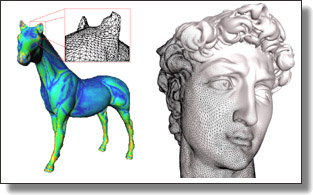 |
Processing
Irregular Meshes
Mathieu Desbrun
In Shape Modelling International
'02 Conference Proceedings
Abstract: Most meshes are
usually produced with both topological and geometrical irregularity (arbitrary
valence, non-uniform sampling). This has been seen as a flaw hindering
subsequent mesh processing, because most of the other signals we manipulate
everyday (sound, image, video) are acquired and processed as regularly
sampled data. Three-dimensional (3D) signals, be they surfaces or volumes,
are however drastically and inherently different. Although the main body
of work on mesh processing has focused on semi-regular meshes (on which
the usual DSP tools can be extended quite nicely), we have focused on fully
irregular meshes. Understanding this problem of irregularity, inherent
to 3D sampling, is fundamental in widely different applications ranging
from mesh modeling to smoothing, parameterization, remeshing, and to even
compression or animation. In this talk, we will show some of our latest
results (both theoretical and practical) and will also point to the remaining
challenges. [This is just a short overview to illustrate an invited
talk]
|
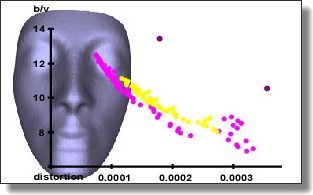 |
Angle-Analyzer:
A Triangle-Quad Mesh Codec
Haeyoung Lee, Pierre
Alliez, and Mathieu Desbrun
In Eurographics 2002 Conference
Proceedings
Abstract: We present Angle-Analyzer,
a new single-rate compression algorithm for triangle-quad hybrid meshes.
Using a carefully-designed geometry-driven mesh traversal and an efficient
encoding of intrinsic mesh properties, Angle-Analyzer produces compression
ratios 40\% better in connectivity and 20% better in geometry than the
leading Touma and Gotsman technique for the same level of geometric distortion.
The simplicity and performance of this new technique is demonstrated, and
we provide extensive comparative tests to contrast our results with the
current state-of-the-art techniques.
|
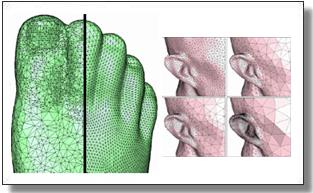 |
Interactive
Geometry Remeshing
Pierre Alliez, Mark Meyer,
and Mathieu Desbrun
In Siggraph 2002 Conference
Proceedings
Abstract: We present a novel
technique, both flexible and efficient, for interactive remeshing of irregular
geometry. First, the original (arbitrary genus) mesh is substituted by
a series of 2D maps in parameter space. Using these maps, our algorithm
is then able to take advantage of established signal processing and halftoning
tools that offer real-time interaction and intricate control. The user
can easily combine these maps to create a control map, a map which controls
the sampling density over the surface patch. This map is then near-optimally
sampled at interactive rates allowing the user to interactively design
a tailored resampling. Once this sampling is complete, a Delaunay triangulation
and fast optimization are performed to perfect the final mesh. As a result,
our remeshing technique is extremely versatile and general being able to
produce arbitrarily complex meshes with a variety of properties including:
uniformity, regularity, semi-regularity, curvature sensitive resampling,
and feature preservation. We provide a high level of control over the sampling
distribution allowing the user to interactively custom design the mesh
based on their requirements thereby increasing their productivity in creating
a large variety of meshes.
|
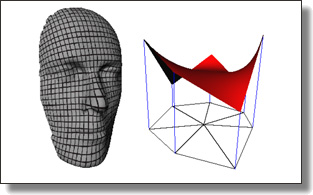 |
Generalized
Barycentric Coordinates for Irregular N-gons
Mark Meyer, Haeyoung
Lee, Alan H. Barr, Mathieu Desbrun
Accepted in Journal of Graphics
Tools
Abstract: In this paper
we develop a generalized form of barycentric coordinates for irregular,
convex n-sided polygons. Triangular barycentric coordinates have had many
classical applications in computer graphics, from texture mapping to ray-tracing.
Our new equations preserve many of the familiar properties of the triangular
barycentric coordinates, which suggests that the new n-sided formulation
can prove to be similarly useful. We exhibit the properties and behavior
of these new generalized barycentric coordinates through several examples
of applications.
|
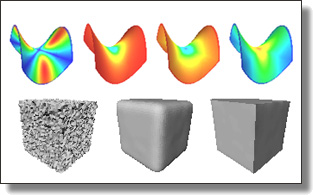 |
Discrete
Differential-Geometry Operators for Triangulated 2-Manifolds
Mark Meyer, Mathieu Desbrun,
Peter Schröder, Alan H. Barr
VisMath '02, Berlin (Germany)
Abstract: This paper provides
a consistent set of flexible tools to approximate important geometric attributes,
including normal vectors and curvatures, on arbitrary 2D and 3D meshes
embedded in n dimensions. We present a consistent derivation of these first
and second order differential properties using Voronoi cells and the mixed
Finite Element/Finite Volume method. The new operators are closely related
to the continuous case, guaranteeing an appropriate extension from the
continuous to the discrete setting: they respect the intrinsic properties
of the continuous differential operators. We show that these estimates
are optimal in accuracy under mild smoothness condi-tions, and demonstrate
their numerical quality. We finally present applications of these operators,
such as mesh smoothing and enhancement, quality checking, and denoising
of arbitrary vectors fields, such as flow fields or tensor images.
|
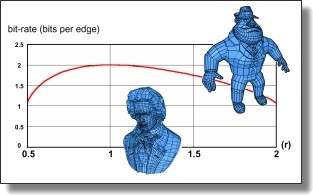 |
Near-Optimal
Connectivity Encoding of 2-Manifold Polygon Meshes
Andrei Khodakovsky, Pierre
Alliez, Mathieu Desbrun, and Peter Schröder
Graphical Models 64(3-4), pp. 147-168, 2002
Abstract: Encoders for triangle
mesh connectivity based on enumeration of vertex valences are among the
best reported to date. They are both simple to implement and report the
best compressed file sizes for a large corpus of test models. Additionally
they have recently been shown to be near-optimal since they realize the
Tutte entropy bound for all planar triangulations. In this paper we introduce
a connectivity encoding method which extends these ideas to 2-manifold
meshes consisting of faces with arbitrary degree. The encoding algorithm
exploits duality by applying valence enumeration to both the primal and
dual mesh in a symmetric fashion. It generates two sequences of symbols,
vertex valences and face degrees, and encodes them separately using two
context-based arithmetic coders. This allows us to exploit vertex and/or
face regularity if present. When the mesh exhibits perfect face regularity
(e.g., a pure triangle or quad mesh) and/or perfect vertex regularity (resp.
valence six or four) the corresponding bit rate vanishes to zero asymptotically.
For triangle meshes, our technique is equivalent to earlier valence driven
approaches. We report compression results for a corpus of standard meshes.
In all cases we are able to show coding gains over earlier coders, sometimes
as large as 50%. Remarkably, this is true even for coders specialized to
triangle or quad meshes. A theoretical analysis re-veals that our approach
is near-optimal as we achieve the Tutte en-tropy bound for arbitrary planar
graphs of 2 bits per edge in the worst case.
|
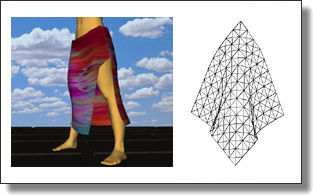 |
Interactive
Animation of Cloth-like Objects in Virtual Reality.
Mark Meyer, Gilles Debunne,
Mathieu Desbrun, Alan H. Barr
The Journal of Visualization
and Computer Animation, Volume 12, Issue 1, May 2001, pages 1-12.
Abstract: Modeling and animation
of cloth has experienced important developments in recent years. As a consequence,
complex textile models can be used to realistically drape objects or human
characters in a fairly efficient way. However, real-time realistic simulation
remains a major challenge, even if applications are numerous, from rapid
prototyping to e-commerce. In this paper, we present a stable, real-time
al-gorithm for animating cloth-like materials. Using a hybrid explicit/implicit
algorithm, we perform fast and stable time integration of a physically-based
model with rapid collision detection and response, as well as wind or liquid
drag effects to enhance realism. We demonstrate our approach through a
series of examples in VR environments, proving that real-time animation
of cloth, even on low-end computers, is now achievable.
|
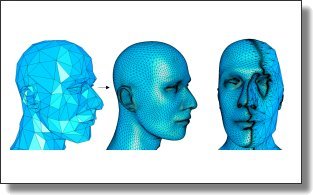 |
Efficient
View-dependent Refinement of 3D Meshes using Sqrt(3)-Subdivision (pdf,
A4 format, 3.5 MBytes)
Pierre Alliez, Nathalie
Laurent, Henri Sanson and Francis Schmitt
In Visual Computer
Abstract: In this paper
we introduce an efficient view dependent refinement technique well-suited
to adaptive visualization of 3D triangle meshes on a graphic terminal.
Our main goal is the design of fast and robust smooth surface reconstruction
from coarse meshes. We demonstrate that the sqrt{3} subdivision operator
recently introduced by Kobbelt offers many benefits, including view-dependent
refinement, removal of polygonal aspect and highly tunable level of detail
adaptation. In particular, we propose a new data structure that requires
neither edges nor hierarchies for efficient and reversible view-dependent
refinement. Results on various 3D meshes illustrate the relevance of the
technique.
|
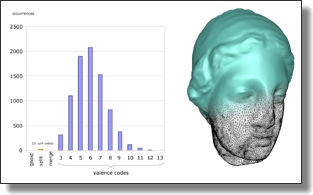 |
Valence-Driven
Connectivity Encoding for 3D Meshes [Slides,
8 MBytes]
Pierre Alliez and Mathieu
Desbrun
In EUROGRAPHICS '2001 Conference
Proceedings
Abstract: In this paper,
we propose a valence-driven, single-resolution encoding technique for lossless
compression of triangle mesh connectivity. Building upon a valence-based
approach pioneered by Touma and Gotsman, we design a new valence-driven
conquest for arbitrary meshes that always guarantees smaller compression
rates than the original method. Furthermore, we provide a novel theoretical
entropy study of our technique, hinting the optimality of the valence-driven
approach. Finally, we demonstrate the practical efficiency of this approach
(in agreement with the theoretical prediction) on a series of test meshes,
resulting in the lowest compression ratios published so far, for both irregular
and regular meshes, small or large.
|
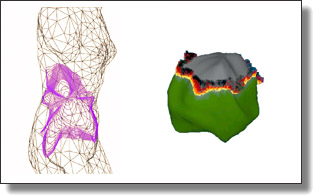 |
Meshes
on Fire
Haeyoung Lee, Laehyun
Kim, Mark Meyer, Mathieu Desbrun
In EG Workshop on Computer
Animation and Simulation '2001
Abstract:We present a new
method for the animation of fire on polyhedral surfaces. Using the notion
of discrete straightest geodesics, we evolve fire fronts directly on the
surface of arbitrarily complex objects. Animator control and motion complexity
is achieved by driving the fire motion using multi-scale turbulent wind
fields and geometric quantities. Our model also supports adaptivity of
the fire fronts, multiple simultaneous fires, and merging of multiple fires.
This new technique produces convincing simulations at interactive rates
even on a low-end PC, greatly increasing the productivity of the animation
design process.
|
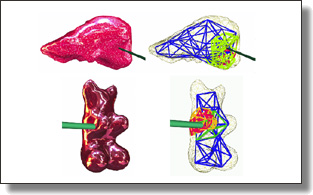 |
Dynamic
Real-Time Deformations using Space and Time Adaptive Sampling
Gilles Debunne, Mathieu
Desbrun, Alan H. Barr and Marie-Paule Cani
In ACM SIGGRAPH '01 Conference
Proceedings
Abstract: This paper presents
a robust, adaptive method for animating dynamic visco-elastic deformable
objects that provides a guaranteed frame rate. Our approach uses a novel
automatic space and time adaptive level of detail technique, in combination
with a large-displacement (Green) strain tensor formulation. The body is
partitioned in a non-nested multiresolution hierarchy of tetrahedral meshes.
The local resolution is determined by a quality condition that indicates
where and when the resolution is too coarse. As the object moves and deforms,
the sampling is refined to concentrate the computational load into the
regions that deform the most. Our model consists of a continuous differential
equation that is solved using a local explicit finite element method. We
demonstrate that our adaptive Green strain tensor formulation suppresses
unwanted artifacts in the dynamic behavior, compared to adaptive mass-spring
and other adaptive approaches. In particular, damped elastic vibration
modes are shown to be nearly unchanged for several levels of refinement.
Results are presented in the context of a virtual reality system. The user
interacts in real-time with the dynamic object through the control of a
rigid tool, attached to a haptic device driven with forces derived from
the method.
|
 |
Progressive
Encoding for Lossless Transmission of 3D Meshes - (1200 dpi,9.8 MBytes)
[300
dpi, 2.4 MBytes] [Slides,
8 MBytes]
Pierre Alliez and Mathieu
Desbrun
In ACM SIGGRAPH '01 Conference
Proceedings
Abstract: Lossless transmission
of 3D meshes is a very challenging and timely problem for many applications,
ranging from collaborative design to engineering. Additionally, frequent
delays in transmissions call for progressive transmission in order for
the end user to receive useful successive refinements of the final mesh.
In this paper, we present a novel, fully progressive encoding approach
for lossless transmission of triangle meshes with a very fine granularity.
A new valence-driven decimating conquest, combined with patch tiling and
an original strategic retriangulation is used to maintain the regularity
of valence. We demonstrate that this technique leads to good mesh quality,
near-optimal connectivity encoding, and therefore a good rate-distortion
ratio throughout the transmission. We also improve upon previous lossless
geometry encoding by decorrelating the normal and tangential components
of the surface. For typical meshes, our method compresses connectivity
down to less than 3.7 bits per vertex, 40% better in average than the best
methods previously reported; we further reduce the usual geometry bit rates
by 20% in average by exploiting the smoothness of meshes. Concretely, our
technique can reduce an ascii VRML 3D model down to 1.7% of its size for
a 10-bit quantization (2.3% for a 12-bit quantization) while providing
a very progressive reconstruction.
|
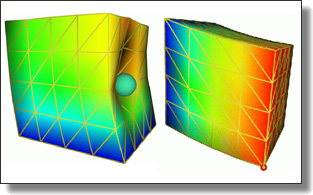 |
Adaptive
Simulation of Soft Bodies in Real-Time
Gilles Debunne, Mathieu
Desbrun, Marie-Paule Cani, Alan H. Barr
In Computer Animation '00
Abstract: This paper presents
an adaptive technique to animate deformable bodies in real-time. In contrast
to most previous work, we introduce a multi-resolution model that locally
refines or simplifies the simulated object over time in order to optimize
the computational effort. We use the mixed Finite-Volume/Finite-Element
method to derive fast, local discrete differential operators over irregular
grids with tight error bounds. The linear elasticity equations can be simulated
using an arbitrary non-nested hierarchy of volumetric meshes, allowing
the computation load to be automatically concentrated where and when needed.
Real-time simulation, with a guaranteed frame rate, can be achieved as
demonstrated through a series of examples on our video.
|
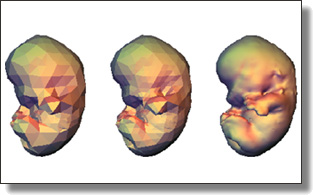 |
Semi-Regular
Mesh Extraction from Volumes
Zoë J. Wood, Mathieu
Desbrun, Peter Schröder, David Breen
In ACM/IEEE Visualization
'00 Proceedings
Abstract: We present a novel
method to extract iso-surfaces from distance volumes. It generates high
quality semi-regular multiresolution meshes of arbitrary topology. Our
technique proceeds in two stages. First, a very coarse mesh with guaranteed
topology is extracted. Subsequently an iterative multi-scale force-based
solver refines the initial mesh into a semi-regular mesh with geometrically
adaptive sampling rate and good aspect ratio triangles. The coarse mesh
extraction is performed using a new approach we call surface wave-front
propagation. A set of discrete iso-distance ribbons are rapidly built and
connected while respecting the topology of the iso-surface implied by the
data. Subsequent multi-scale refinement is driven by a simple force-based
solver designed to combine good iso-surface fit and high quality sampling
through reparameterization. In contrast to the Marching Cubes technique
our output meshes adapt gracefully to the iso-surface geometry, have a
natural multiresolution structure and good aspect ratio triangles, as demonstrated
with a number of examples.
|
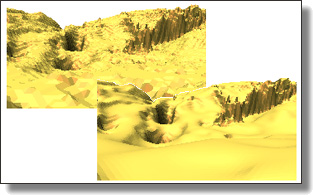 |
Anisotropic
Feature-Preserving Denoising of Bivariate Data
Mathieu Desbrun, Mark
Meyer, Peter Schröder, Alan H. Barr
In Graphics Interface '00
Proceedings
Abstract: In this paper,
we present an efficient way to denoise bivariate data like height fields,
color pictures or vector fields, while preserving edges and other features.
Mixing surface area minimization, graph flow, and nonlinear edge preservation
metrics, our method generalizes previous anisotropic diffusion approaches
in image processing, and is applicable to data of arbitrary dimension.
Another notable difference is the use of a more robust discrete differential
operator, which captures the fundamental surface properties. We demonstrate
the method on range images and height fields, as well as greyscale or color
images.
|
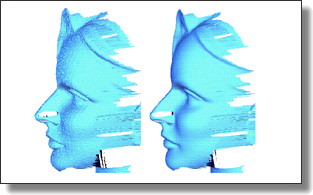 |
Implicit
Fairing of Arbitrary Meshes using Diffusion and Curvature Flow
Mathieu Desbrun, Mark
Meyer, Peter Schröder, Alan H. Barr
In ACM Siggraph '99 Proceedings
Abstract: In this paper,
we develop methods to rapidly remove rough features from irregularly triangulated
data intended to portray a smooth surface. The main task is to remove undesirable
noise and uneven edges while retaining desirable geometric features. The
problem arises mainly when creating high-fidelity computer graphics objects
using imperfectly-measured data from the real world. Our approach contains
three novel features: an implicit integration method to achieve efficiency,
stability, and large time-steps; a scale-dependent Laplacian operator to
improve the diffusion process; and finally, a robust curvature flow operator
that achieves a smoothing of the shape itself, distinct from any parameterization.
Additional features of the algorithm include automatic exact volume preservation,
and hard and soft constraints on the positions of the points in the mesh.
We compare our method to previous operators and related algorithms, and
prove that our curvature and Laplacian operators have several mathematically-desirable
qualities that improve the appearance of the resulting surface. In consequence,
the user can easily select the appropriate operator according to the desired
type of fairing. Finally, we provide a series of examples to graphically
and numerically demonstrate the quality of our results.
|
 |
Interactive
multiresolution animation of deformable models
Gilles Debunne, Mathieu
Desbrun, Alan Barr, and Marie-Paule Cani
In Eurographics Workshop
on Computer Animation and Simulation '99
Abstract: This paper presents
an approach to animate elastic deformable materials at interactive rates
using space-time adaptive resolution. We propose a new computational model,
based on the conventional Hooke’s law, that uses a discrete approximation
of differential operators on irregular grid. It allows local refinement
or simplification of the computational model based on local error measurement.
We in effect minimize calculations while ensuring a realistic and scale-independent
behavior within a given accuracy threshold. We demonstrate this technique
on a real-time virtual liver surgery application.
|
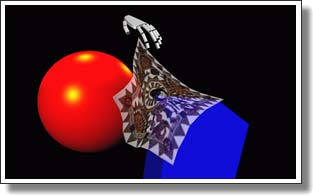 |
Interactive
Animation of Structured Deformable Objects
Mathieu Desbrun, Peter
Schröder, Alan H. Barr
In Graphics Interface '99
Abstract: In this paper,
we propose a stable and efficient algorithm for animating mass-spring systems.
An integration scheme derived from implicit integration allows us to obtain
interactive realistic animation of any mass-spring network. We alleviate
the need to solve a linear system through the use of a predictor-corrector
approach: We first compute a rapid approximation of the implicit integration,
then we correct this estimate in a post-step process to preserve momentum.
Combined with an inverse kinematics process to implement collisions and
other constraints, this method provides a simple, stable and tunable model
for deformable objects suitable for virtual reality. An implementation
in a VR environment demonstrates this approach.
|
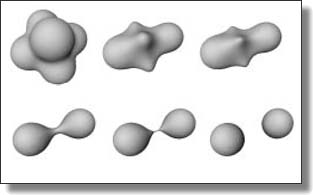 |
Active
Implicit Surface for Animation
Mathieu Desbrun and Marie-Paule
Cani-Gascuel
In Graphics Interface'98
Abstract:This paper introduces
a new model of deformable surfaces designed for animation, which we call
active implicit surfaces. The underlying idea is to animate a potential
field defined by discrete values stored in a grid, rather than directly
animating a surface. This surface, defined as an iso-potential of the field,
has the ability to follow a given object using a snake-like strategy. Surface
tension and other characteristics such as constant surface area or constant
volume may be added to this model. The implicit formulation allows the
surface to easily experience topology changes during simulation. We present
an optimized implementation: computations are restricted to a close neighborhood
around the surface. Applications range from the coating of deformable materials
simulated by particle systems (the surface hides the granularity of the
underlying model) to the generation of metamorphosis between shapes that
may not have the same topology.
|
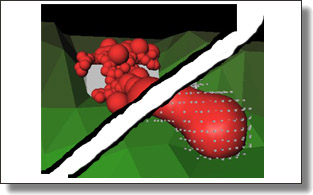 |
Space-Time
Adaptive Simulation of Highly Deformable Substances
Mathieu Desbrun, Marie-Paule
Cani
INRIA Technical Report, '98
Abstract: This report presents
an approach for efficiently, yet precisely simulating highly deformable
substances ranging from solids to liquids. The key idea is to use a state
equation for specifying the dynamics of the substance. During a simulation,
the material is sampled by particles that derive their interaction forces
from this state equation. Since this ensures the same qualitative behavior
whatever the discretization rate, an adaptive scheme can be used during
simulations: the particle system adapts over space and time according to
a given compromise between precision and computational efficiency. The
system refines (i.e., particles are subdivided) in areas undergoing large
or fast deformations, while it simplifies (i.e., neighboring particles
are merged) in stable regions. Meanwhile, the values of the individual
integration time steps used for each particle are automatically adapted
to avoid instabilities. An active implicit surface is used to visualize
the substance. It smoothly coats the particles and filters internal changes
of granularity over time..
|
 |
Animation
of Deformable Models using Implicit Surfaces
Marie-Paule Cani-Gascuel
and Mathieu Desbrun
IEEE Transactions on Vision
and Computer Graphics, March 97
Abstract: This paper presents
a general approach for designing and animating complex deformable models
with implicit surfaces. Implicit surfaces are introduced as an extra layer
coating any kind of structure that moves and deforms over time. O ering
a compact de nition of a smooth surface around an object, they provide
an efficient collision detection mechanism. The implicit layer deforms
in order to generate exact contact surfaces between colliding bodies. A
simple physically-based model approximating elastic behavior is then used
for computing collision response. The implicit formulation also eases the
control of the object's volume with a new method based on local controllers.
We present two different applications that illustrate the benefits of these
techniques. First, the animation of simple characters made of articulated
skeletons coated with implicit flesh exploits the compactness and enhanced
control of the model. The second builds on the specific properties of implicit
surfaces for modeling soft inelastic substances capable of separation and
fusion that maintain a constant volume when animated.
|
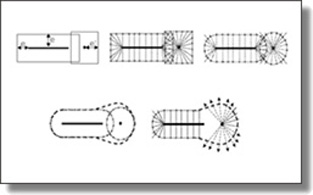 |
Adaptive
Sampling of Implicit Surfaces for Interactive Modeling & Animation
Mathieu Desbrun, Nicolas
Tsingos and Marie-Paule Gascuel
in Computer Graphics Forum,
15(5), Dec. 96
Abstract: This paper presents
a new adaptive sampling method for implicit surfaces that can been used
in both interactive modeling and animation. The algorithm samples implicit
objects generated by skeletons and efficiently maintains this sampling,
even when their topology changes over time such as during fractures and
fusions. It provides two complementary modes of immediate visualization:
displaying "scales" lying on the surface, or a piecewise polygonization.
The sampling method is particularly well suited to efficiently avoid "unwanted
blending" between different parts of an object. Moreover, it can be used
for partitioning the implicit surface into local bounding boxes that will
accelerate collision detection during animations and ray-intersections
during final rendering.
|
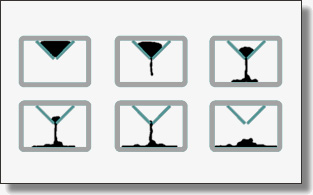 |
Smoothed
Particles: A new paradigm for highly deformable bodies
Mathieu Desbrun and Marie-Paule
Gascuel
In 6th Eurographics Workshop
on Animation and Simulation'96
Abstract: This paper presents
a new adaptive sampling method for implicit surfaces that can been used
in both interactive modeling and animation. The algorithm samples implicit
objects generated by skeletons and efficiently maintains this sampling,
even when their topology changes over time such as during fractures and
fusions. It provides two complementary modes of immediate visualization:
displaying \scales" lying on the surface, or a piecewise polygonization.
The sampling method is particularly well suited to efficiently avoid "unwanted
blending" between different parts of an object. Moreover, it can be used
for partitioning the implicit surface into local bounding boxes that will
accelerate collision detection during animations and ray-intersections
during final rendering.
|
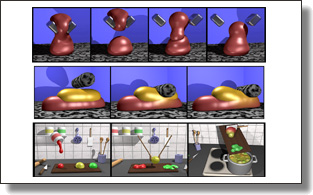 |
Animating
Soft Substances with Implicit Surfaces
Mathieu Desbrun and Marie-Paule
Gascuel.
In SIGGRAPH'95 Proceedings
Abstract: This paper presents
a hybrid model for animation of soft inelastic substance which undergo
topological changes, e.g. separation and fusion and which fit with the
objects they are in contact with. The model uses a particle system coated
with a smooth iso-surface that is used for performing collision detection,
precise contact modeling and integration of response forces. The animation
technique solves three problems inherent in implicit modeling. Firstly,
local volume controllers are defined to insure constant volume deformation,
even during highly inelastic processes such as splitting or fusion. Secondly,
we avoid unwanted distance blending between disconnected pieces of the
same substance. Finally, we simulate both collisions and progressive merging
under compression between implicit surfaces that do not blend together.
Parameter tuning is facilitated by the layered model and animation is generated
at interactive rates.
|